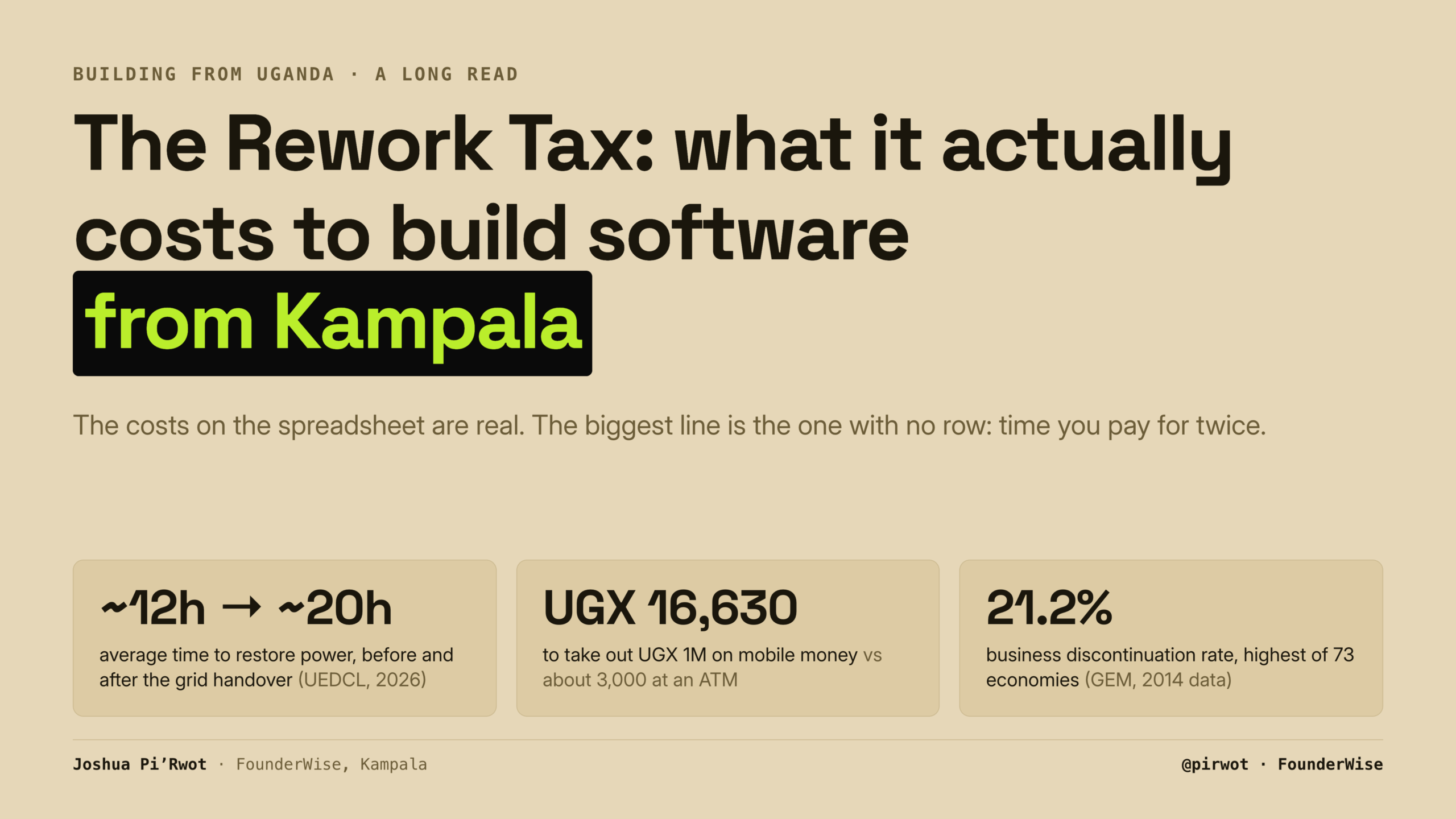
Ask a founder in Kampala what it costs to build here and you will usually get a list of prices: data bundles, a generator and its fuel, the mobile money fee, the dollar rate this week. Those costs are real, and I’ll go through them. After nine years running founder programs in Uganda as Country Director of the AVODA Institute of Entrepreneurship, with more than 600 founders trained and over 100 startups supported, I think that list misses the biggest line.
The biggest line is rework. It’s the hour spent redoing the upload the outage ate. It’s the payment you retry on a second card, then a third. It’s the afternoon spent rewriting your company description for a partner abroad who has to check you from a distance and has few ways to do it. It’s the week of product time that goes into proving your company exists. Spreadsheets record what you paid for once. Rework is time you pay for twice, and it rarely gets a row.
I call it the rework tax. This piece is my attempt to put numbers around it, using public data wherever I can, and to be fair about what these same conditions give the people who build here.
The week the internet went off
On 13 January this year, at 6pm, the Uganda Communications Commission ordered public internet access suspended, two days before the general election. VPNs were ordered disabled. Starlink terminals had already been switched off from 1 January. General internet came back late on 17 January, after roughly 100 hours. Social media stayed blocked until 26 January.
CIPESA, the Kampala-based digital rights research group, estimated the loss to Uganda’s digital economy at UGX 59.7 billion, about US$16 million, over those five days, plus further losses from the social media and mobile money constraints that followed. Estimates vary, and I treat CIPESA’s as the careful one.
It was the second election shutdown in a row. In January 2021 the internet was cut from the 13th to the 18th, and the Internet Society’s cost tool estimated about US$9 million in losses. Facebook was blocked that same month, after Meta removed accounts linked to the government, and it stayed blocked for about five and a half years. In June this year a minister announced it was back. The regulator gave no formal confirmation at the time.
The headline figure measures the days offline. For a small software team the harder part comes after. Support tickets pile up. Payments stall halfway through. Scheduled jobs fail and queue behind each other. Then the connection returns, and the following week goes into cleanup: reconciling what went through, apologizing to users, re-running what broke. The five days are the visible part. The cleanup is the tax.
Power
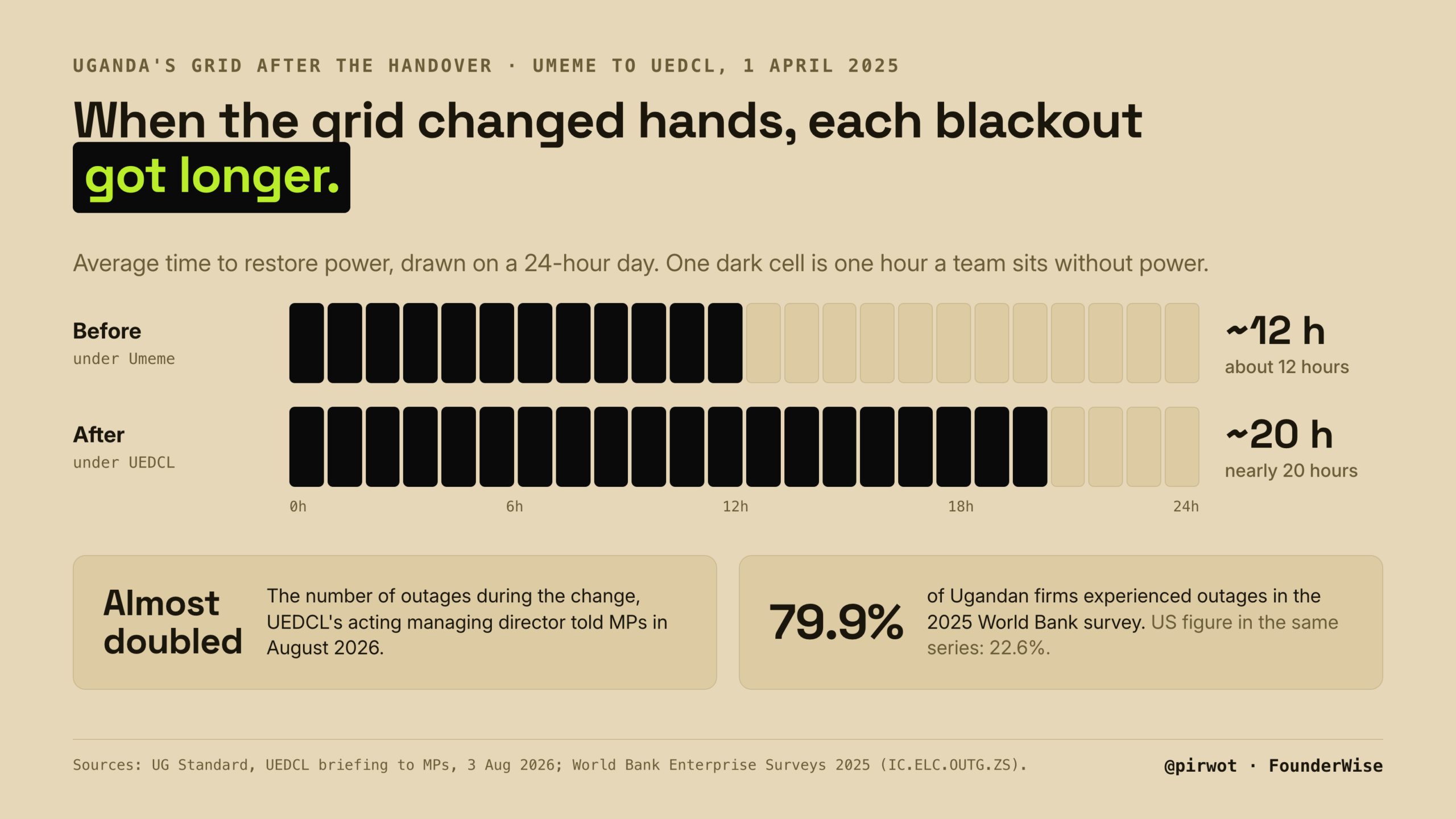
The World Bank’s 2025 Enterprise Survey for Uganda found that 79.9% of firms experienced electrical outages. Kenya’s figure in the same round was 74.6%, Nigeria’s 82.5%, and the sub-Saharan average 72.4%. The comparable US figure in the World Bank series is 22.6%.
The 2025 frequency has yet to be published, so the last numbers carry an old date: in the 2013 survey, affected Ugandan firms saw 6.3 outages in a typical month, averaging 10.1 hours each, and put their losses at 11.2% of annual sales. That is thirteen years old. My guess is that it has improved less than we’d hope, and I’d call that a guess.
The grid also changed hands. Umeme’s 20-year distribution concession ended at midnight on 31 March 2025, and the state-owned UEDCL took over the next day. In August this year, UEDCL’s acting managing director told MPs that outages had almost doubled during the change, and that average restoration time rose from about 12 hours to nearly 20, as the UG Standard reported. The Electricity Regulatory Authority has described the transition as smooth. Both statements are on the record, and founders can weigh them against their own logs.
For a builder, an outage costs more than the hours in the dark. A build half-finishes. A database migration stops in the middle. A laptop dies during a customer demo. Every founder I’ve worked with here has a routine for the moment the lights go, and every routine has a price: a generator, a UPS, a backup data bundle, a second place to work, or the plain discipline of saving and pushing work every hour. The discipline is sensible. It is also time spent managing the grid.
Connectivity and its price
The International Telecommunication Union’s 2025 price data puts a basic fixed broadband plan (5GB) at 33.98% of monthly income per person in Uganda. In the United States the same basket costs 0.76%. In dollars the Ugandan plan is cheaper, $30.45 against $54.44, and it still takes about a third of an average month’s income. A 2GB mobile data plan costs 3.03% of monthly income here, above the UN Broadband Commission’s 2% target.
Prices are moving in the right direction. The Daily Monitor reported this year that the cost per gigabyte fell from above UGX 5,000 in 2020 to about UGX 2,000. 4G now covers 82% of people, though about three in four of those covered stay offline.
Some of the cost is policy. In July 2018 Uganda introduced the OTT tax, UGX 200 a day to use social media. Internet penetration fell from 47% to 35% within three months, and revenue came in far below target. In July 2021 it was replaced by a 12% excise duty on data, with 18% VAT on top. Every gigabyte a developer uses to pull dependencies, sync a repository or push a build carries that levy.
For software founders this matters twice, because your users pay the same prices. A product that assumes cheap, constant data loses people at the first heavy page. So teams here build light, cache aggressively and design for connections that drop. That is good engineering. It is also extra engineering, and it lands on teams with the least time to spare.
Money in, money out
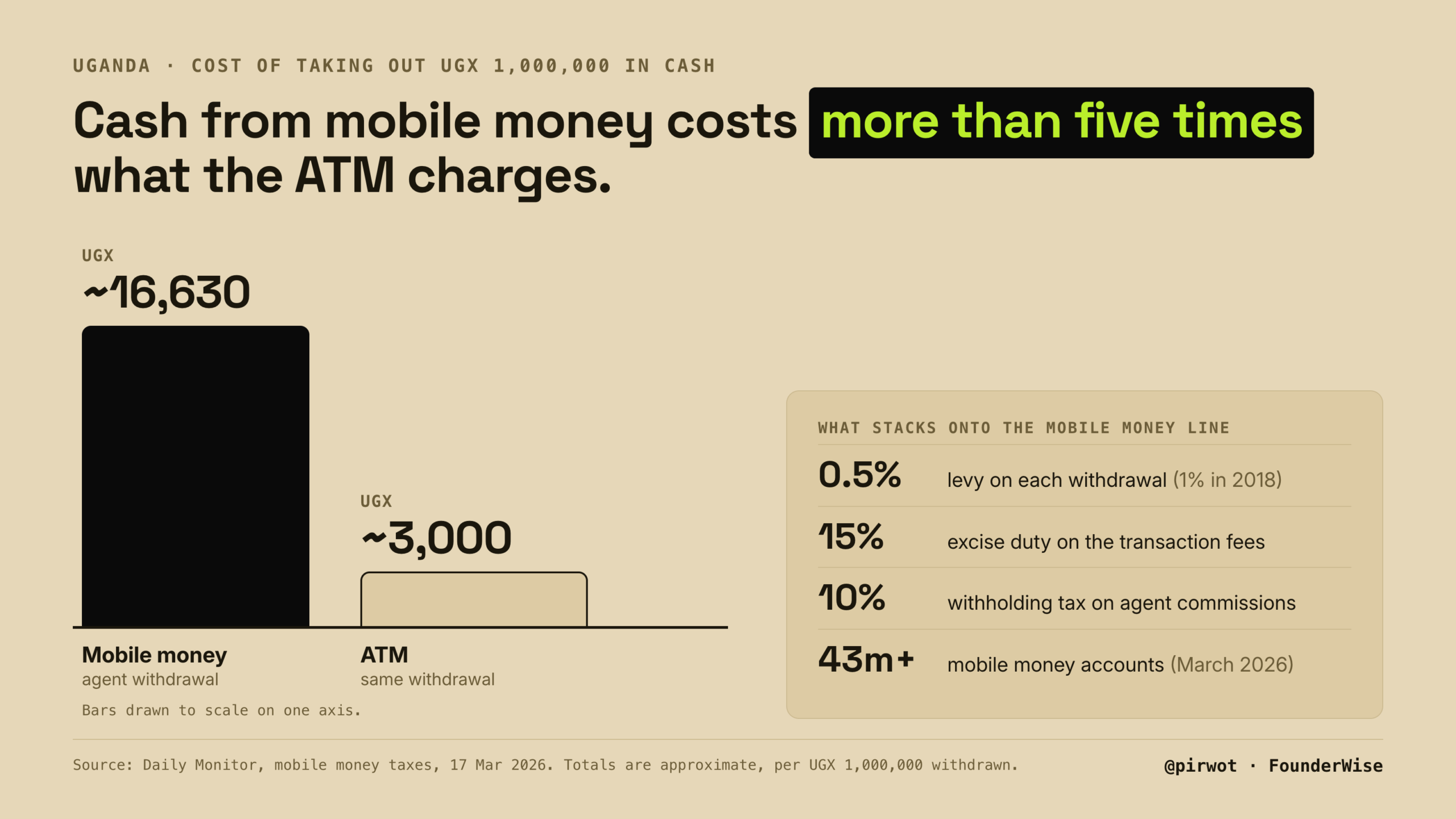
Mobile money is the country’s real payment rail. The Monitor reported in March more than 43 million registered accounts and 8.4 billion transactions a year, worth about UGX 326.3 trillion. It is taxed accordingly. A levy of 0.5% applies to withdrawals. It started at 1% in 2018 and was cut within months after usage dropped, and a plan to halve it again for 2026/27 was dropped by the Finance ministry in April. Add a 15% excise on the fees and 10% withholding on agent commissions, and taking out UGX 1 million costs about UGX 16,630. The same withdrawal at an ATM costs about UGX 3,000.
Getting paid by the rest of the world is harder. Stripe’s own global page lists five African countries, all through its Paystack “extended network”: Côte d’Ivoire, Ghana, Kenya, Nigeria and South Africa. Uganda is absent, and Paystack says its services are available only to businesses registered in Nigeria, Ghana, South Africa and Kenya. Shopify Payments supports 38 countries, all of them outside Africa. Lemon Squeezy pays out to banks in Kenya, Tanzania and Rwanda, and Uganda is missing from that list. Many Ugandan sources report that local PayPal accounts can send money and are unable to receive it. PayPal’s public pages say only that availability varies by country, so I attribute that one to local experience.
Buying tools costs more too. Uganda charges 18% VAT on imported digital services, and from 1 July 2025 it replaced a 5% digital services tax on foreign providers with a 15% withholding tax on non-resident digital service income, according to tax trackers. Every SaaS subscription a Ugandan founder pays for can carry some of that.
The shilling adds its own drift. It moved from about 3,644 to the dollar on 20 June to about 3,937 on 19 September, and Bank of Uganda raised the cash reserve requirement to 13.5% this month to defend it. If your tools are priced in dollars and your customers pay in shillings, an 8% swing in three months comes straight out of margin.
The standard workaround is well known: form a Delaware company and use US rails. Stripe Atlas does the formation for $500. Briter reported that 50% of African startup funding in the first half of 2026 went to entities incorporated outside Africa. The legal entity turns out to be the easy part.
The presence problem
This is where my own year comes in. FounderWise, LLC is a Delaware company. Our team works from Kampala.
Since 1 July 2025, Stripe has required a physical US presence for its Treasury, Issuing and Opal accounts, and it states that an Atlas registered agent address will fail that test. Several US corporate card providers publish similar requirements: a physical US address, US operations, and an explicit exclusion of virtual offices, registered agents and mail-forwarding services. The gate is location. Nationality barely enters into it.
This year a US card provider declined FounderWise because we have no US presence. Later our bank froze our card. I’m leaving the providers unnamed, because they applied their rules as written. The rules are about where you sit, and I sit here.
The IRS makes the same point through timing. Stripe’s own guide says an EIN takes 1 to 15 business days for a founder with a US address, a US phone number and a Social Security number, and 15 to 50 business days for a founder missing any of the three.
The rework here is re-verification. Every declined application means another round of documents, another explanation of how a Ugandan-run Delaware company works, another wait. Each round takes a week or more of founder attention, and that attention comes out of the product.
The founders I train face the same thing at a smaller scale and with fewer options. The World Bank’s last measurement, in 2019, put private credit bureau coverage at 6.9% of Ugandan adults, against 100% in the US. The 2025 Global Findex found that 26.2% of Ugandan adults have a bank or similar account, down from 36.6% in 2021. In the 2025 Enterprise Survey, 26% of Ugandan firms had a bank loan or credit line, against 46.8% in Kenya. Shilling lending rates ran between about 17% and 19% through the first half of 2026, according to Bank of Uganda figures reported by The Cooperator. A founder can run a real business for years and still look unreadable to a lender, a card issuer or a program abroad.
Starting and stopping
Ugandans start businesses at a remarkable rate. The last time the Global Entrepreneurship Monitor surveyed Uganda, in its 2014 report covering 73 economies, 35.5% of adults aged 18 to 64 were starting or running a new business, second only to Cameroon. Uganda also had the highest business discontinuation rate of all 73, at 21.2%.
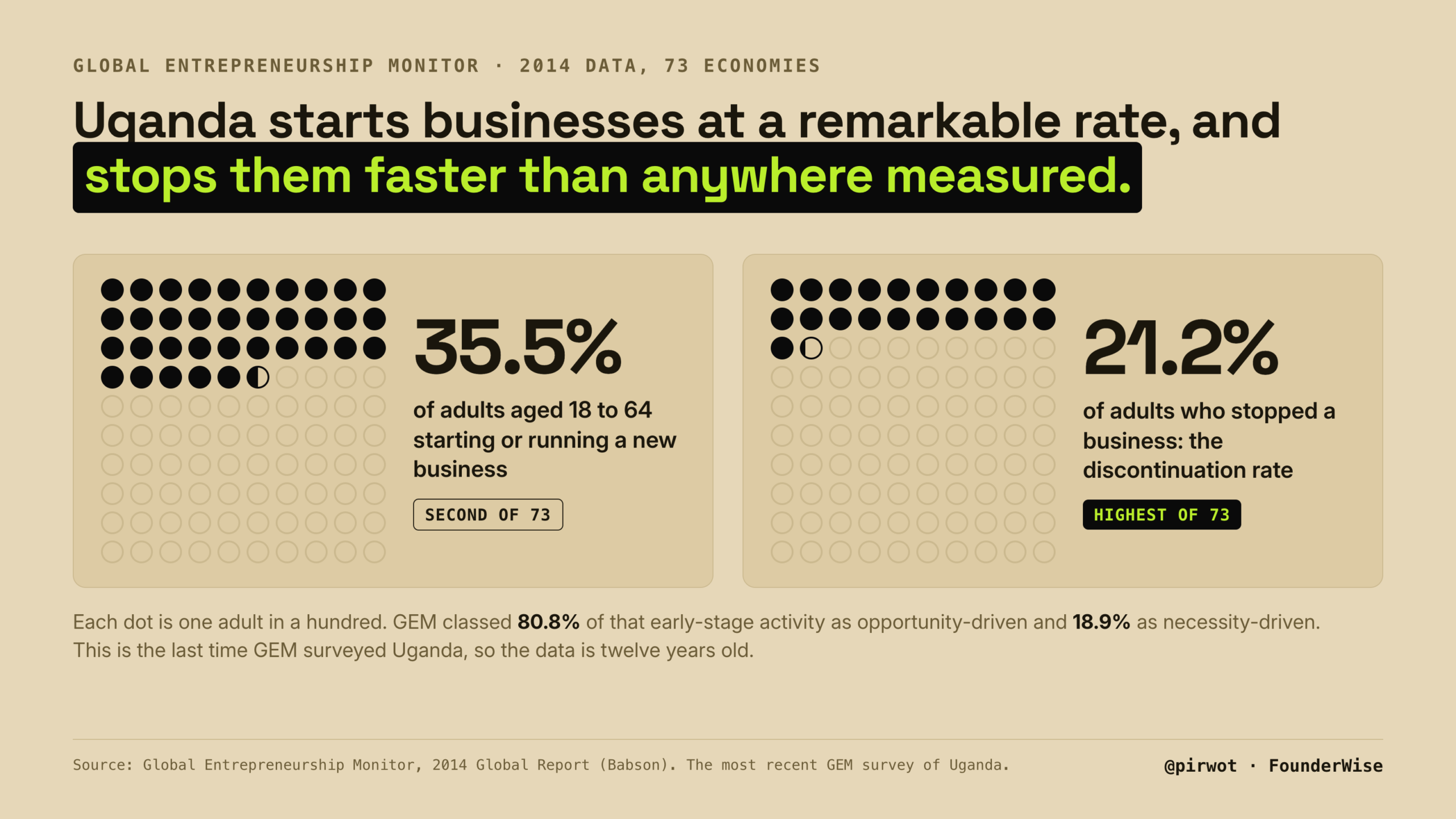
GEM’s own classification matters here. It counted 80.8% of that early-stage activity as opportunity-driven and only 18.9% as necessity-driven, so the common “necessity entrepreneurship” label comes from commentators. My reading is that people see real openings and act on them fast, and a lot of them stop because the ground keeps moving. That data is twelve years old, and I’d hold my reading loosely until GEM measures Uganda again.
The pressure behind it is current. The 2024 census found 42.6% of Ugandans aged 15 to 24 were out of employment, education or training. The modeled youth unemployment rate is about 4.2%, which hides the picture, because most young people here cannot afford to be unemployed. They start something.
Capital and distance
Partech‘s 2025 report counted US$4.1 billion raised by African tech startups. Kenya, South Africa, Egypt and Nigeria took 72% of it. Uganda raised about US$22 million, tenth in Africa. Africa: The Big Deal, counting differently, put Kampala at about US$30 million. Either way it is under 1% of the continent’s total. Partech counted 25 active equity investors in Uganda in 2025, up from 12 the year before, which is a small number moving the right way.
For scale, US rounds under $100 million, leaving the megadeals aside, drew $51.4 billion in the first half of 2026, according to the PitchBook-NVCA Venture Monitor. That is about twelve times Africa’s full-year 2025 total, in six months.
Distance compounds it. Y Combinator took 23 to 24 African startups in its Winter 2022 batch. After it began requiring founders to move to San Francisco, that fell to 3 in Winter 2023, and an analysis of the Winter 2026 batch found zero startups from emerging markets. A YC spokesperson told TechCrunch the requirement “has naturally changed the composition of startups that apply to YC.”
Travel carries its own charges. State Department figures for fiscal 2025, as reproduced by visa trackers, put the US B1/B2 refusal rate for Ugandans at 57.58%. Since 18 May 2026 the US embassy in Kampala has reportedly paused visa services because of the Ebola outbreak. The LAGO Collective estimated that Africans lost about €60 million in non-refundable Schengen visa fees in 2024. For a Ugandan founder, a demo day abroad can mean a fee, a refusal and a lost month.
My own record this year sits inside that picture: thirteen accelerator rejections and one acceptance, into the 1752vc GTM Accelerator. I’m careful about reading too much into fourteen decisions. Some were about us, and some were about fit. What I can see is that the evidence of our work is hard to read from far away, and the same holds for many founders I’ve trained.
What these conditions produce
The cost side is only half of the story, and the other half is real.
Mobile money is the clearest case. In a 2016 study in Science, Tavneet Suri and William Jack found that access to M-Pesa lifted about 194,000 Kenyan households, around 2%, out of poverty, and moved about 185,000 women from farming into business. In Uganda, 67.7% of adults have a mobile money account and 26.2% have a bank account, per the 2025 Global Findex. Among the poorest 40%, account ownership rose from 51.4% to 66.9% between 2021 and 2024. This region built a payment habit the rest of the world later studied, and the gains are measurable.
The local rails work. Flutterwave is licensed in Uganda and publishes its fees: 3.0% on mobile money collections, 3.2% on local cards. Google Play supports developer and merchant registration from Uganda, and Apple lists a Ugandan shilling payout threshold, so app store proceeds can land in a Ugandan bank. In the 2025 Enterprise Survey an operating license took about 7.1 days here, against a sub-Saharan average of 17.6. Licensing is quicker than outsiders tend to assume.
Frugal building is a skill, and it compounds. When a whole country raises about US$22 million in a year, whatever gets built is built on very little. SafeBoda left Nigeria in December 2022 because the market was unprofitable, refocused on Uganda, and is still operating; Uber exited Uganda this month. Xente pivoted from consumer to business payments during COVID and now serves more than 300 business clients under a Bank of Uganda license. Numida raised $12.3 million in 2022, and Rocket Health, founded in 2012, raised a $5 million Series A that same year. Crane AI is building offline language models for Ugandan languages.
David Gonahasa of Tripesa put the mood well in a 2025 interview with TechCabal: “Our entrepreneurs do not have the luxury of easy money. We have had to hustle, and hustle, we will.” I’d add one thing. The hustle is mostly unglamorous. It’s the rework, done patiently, over and over.
Putting the rework on the spreadsheet
I’ve yet to measure the rework tax properly across my own cohorts, so treat what follows as working practice from nine years of watching founders, and my guess at where the hours go.
The first habit is to count it. Keep a simple log of hours lost to outages, shutdowns, failed payments and re-verification. Most founders I’ve worked with are surprised by the total at the end of a month, and a number you can see is a number you can plan around.
The second is to checkpoint everything. Commit and push code often. Save drafts to the cloud as you go. Design products to queue work offline and sync when the connection returns, because your users live with the same grid you do.
The third is to keep two of every rail: two ways to get paid, two ways to pay for tools, two places to work when the power goes. Redundancy costs a little every month and saves the expensive week.
The fourth is to keep a verification pack ready. Registration documents, a bank letter, a short plain description of the company, and hard evidence of the work: customers spoken to, an MVP tested, cash that came in. When the next provider or program asks, you send a folder instead of rebuilding your case from memory.
Why I’m building from here
That fourth habit is most of why FounderWise exists. The founders I’ve trained do real work that is hard to prove from a distance, and my own company ran into the same wall this year. It made sense to build the tool where the problem lives.
MVP Studio went live on 25 September. Seven founders from our first cohort signed up within three hours. It helps a founder plan and test an MVP and keep the evidence of that work in one place, in a form a program, lender or investor can read. Revenue today is zero. Seven sign-ups tells me the need is real for that cohort. It tells me very little yet about whether founders or programs will pay, and I’ll know more in a few months than I do today.
I could also be too close to this to judge which cost matters most. My bet remains the rework, because it’s the one that stays invisible on every spreadsheet until someone starts counting.
If you’re a founder building your first product, or a program that supports founders, MVP Studio is open at app.founderwise.io/mvp. If you’d like to talk through what the rework tax looks like in your company or your program, you can book a strategy call with me at cal.com/pirwot/strategy-call.
If you build from somewhere the power and the internet come and go, what’s the one habit that has saved you the most rework?
Sources
- World Bank Enterprise Surveys, firms experiencing outages
- UG Standard, UEDCL outages before MPs (3 Aug 2026)
- Human Rights Watch on the January 2026 shutdown
- CIPESA, impact of the 2026 shutdown
- Internet Society, cost of the 2021 shutdown
- Pulse Uganda on Facebook’s return
- ITU ICT Price Baskets 2008-2025
- Daily Monitor on cheaper internet
- The Observer on the OTT tax
- Daily Monitor on mobile money taxes
- Stripe global availability
- VATupdate on Uganda’s withholding tax
- Bloomberg on the shilling and reserve ratio
- Stripe physical presence requirement
- Stripe guide to US bank accounts and EIN timing
- Briter Africa Venture Pulse 2026
- The Cooperator on lending rates
- World Bank Global Findex
- GEM 2014 Global Report
- UBOS 2024 census report
- Partech 2025 Africa Tech VC Report
- The EastAfrican on Uganda’s 2025 funding
- PitchBook-NVCA Venture Monitor Q2 2026
- TechCrunch on YC and Africa
- US visa refusal rates (reproduced)
- Bloomberg on the Kampala visa pause
- LAGO Collective on Schengen fees
- Suri and Jack, Science (2016)
- Flutterwave in Uganda
- TechCabal on Uganda’s tech sector