A founder sent me a pre-seed deck in July that would have raised money in 2022.
The deck was good. Clean problem statement, a market she actually understood because she had worked in it for six years, a prototype that worked, and a plausible wedge. Two years ago that deck raises three hundred thousand dollars in a month.
She sent it to thirty-one investors. She got four calls and no check. The most common piece of feedback, when she got any, was a version of “come back when there is more”.
She read that as rejection. It was a price update.
The pre-seed market did not shrink. It stopped writing small checks.
What Actually Happened To The Money
Start with the number everyone gets backwards.
Pre-seed dollars did not fall
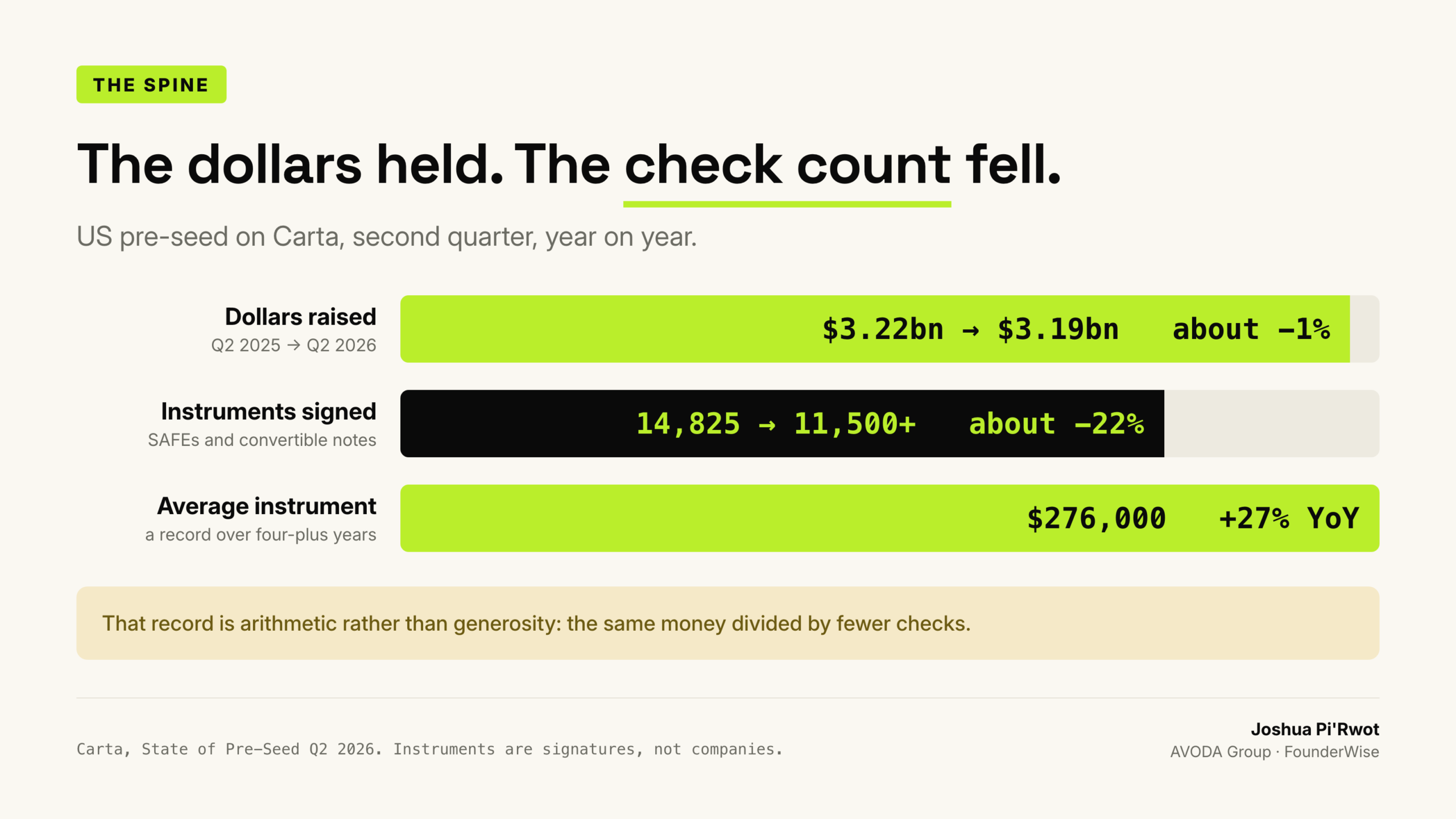
In the second quarter of 2026, US startups on Carta raised 3.19 billion dollars across more than 11,500 pre-seed instruments. In the same quarter a year earlier they raised 3.22 billion across 14,825 instruments.
Read those two sentences again, because the interesting part sits in the check count. The money moved by about one percent. The number of checks fell by roughly a fifth.
The annual picture has the same shape. Across all of 2025, Carta recorded 10.4 billion dollars across 50,316 SAFEs and convertible notes: capital down one percent, instrument count down thirteen percent.
So the average instrument size hit 276,000 dollars in Q2 2026, up twenty-seven percent year over year and the highest in more than four years. That record is arithmetic rather than generosity: the same money divided by fewer checks.
The pre-seed market did not shrink. It stopped writing small checks.
That distinction is the whole thing, and it changes what a founder should do about it.
“The market is down” implies waiting. It suggests the capital left and will return, and that the right move is to survive until it does. That is wrong, and acting on it costs a year.
“The market concentrated” implies something else entirely. The money is there. It is arriving in fewer, larger, more deliberate envelopes, which moves the question from whether capital exists for companies like yours to whether you are one of the fewer.
The Middle Is What Disappeared
Here the data gets more specific than the headline, and more useful.
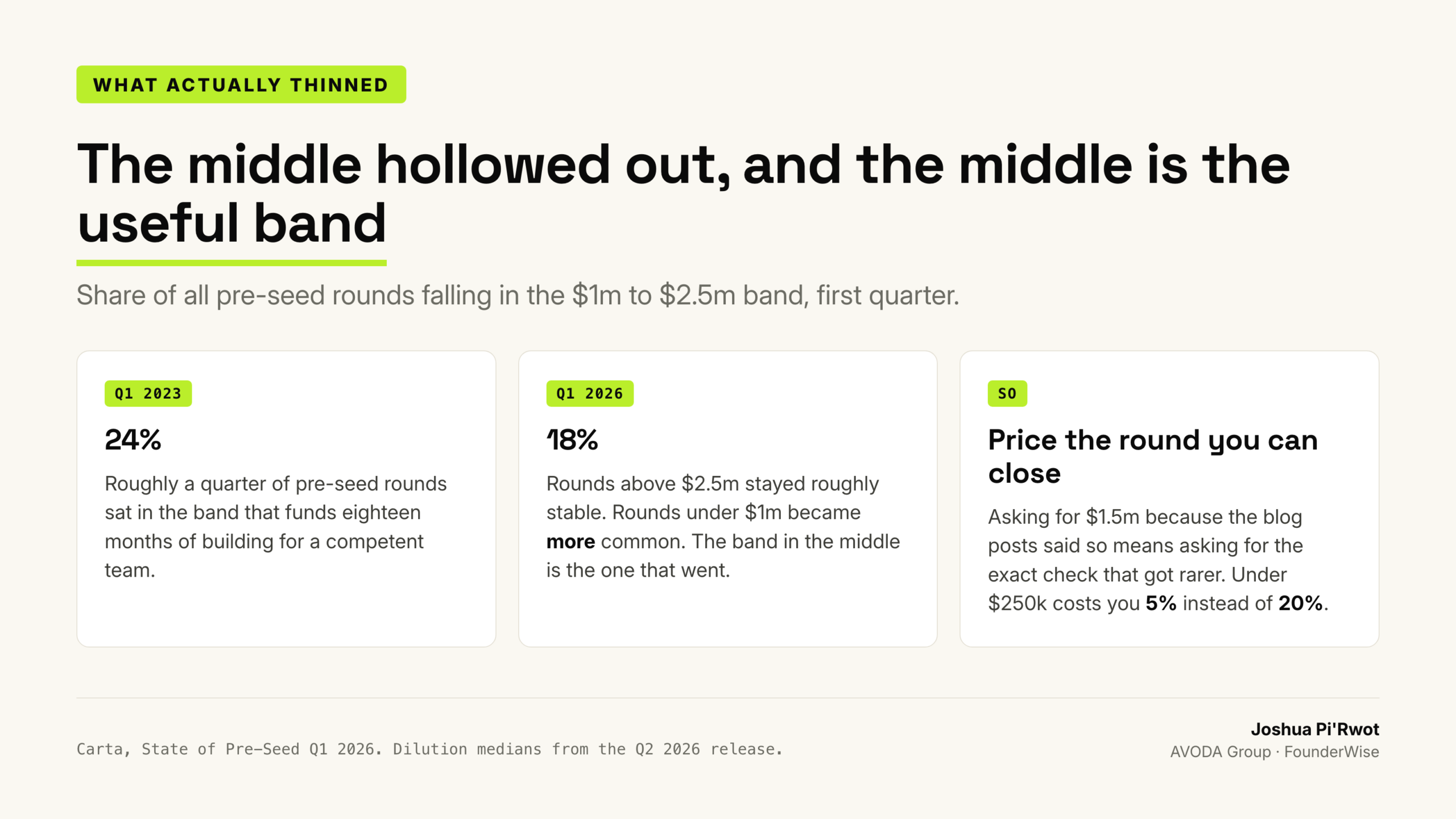
Rounds between one million and 2.5 million dollars made up twenty-four percent of all pre-seed rounds in the first quarter of 2023. By the first quarter of 2026 they made up eighteen percent. Rounds above 2.5 million stayed roughly stable. Rounds under one million became more common.
The lazy reading is that the market moved upmarket. What it actually did was hollow out in the middle. The very small check survived. The large check survived. The ordinary institutional pre-seed, the one that funds eighteen months of building for a competent team with a reasonable idea, is the thing that thinned.
Why that specific band matters
That band was the one that did the most work in the ecosystem. It is too big for friends and family and too small to require the kind of proof a seed round demands. It is the money that let people find out whether a thing worked.
It is also, by no accident, the band my July founder was asking for.
Why Concentration Happens, Mechanically
It is tempting to read this as investors becoming timid. The arithmetic says something else.
A fund has a fixed number of decisions in it. Not money. Attention. Every check, however small, carries the same diligence call, the same reference checks, the same board update, the same awkward conversation when it goes wrong. A 250,000 dollar check and a 2 million dollar check cost roughly the same to make and to carry.
So when a fund gets larger, and most of them did, the small check stops being worth the slot. The bet may be sound. A fund that has to return three hundred million dollars simply cannot get there on positions that cap out at a few million, however many of them work.
What follows from that
The founder-facing consequence is specific and unintuitive. The investor who passed on you may well believe your company will work. Belief is only half of it. The company also has to be able to get big enough to matter to a fund of that size, and that calculation is about their arithmetic rather than your business.
This is why “come back when there is more” is so common and so maddening. Often it is a statement about check size rather than evidence: at your current stage, the check that fits you is smaller than the smallest one they can write.
A pass is sometimes a portfolio-construction fact wearing the costume of an opinion about your business.
So stop pitching funds whose arithmetic excludes you. That means knowing their fund size and their target position size. Both are usually findable in ten minutes. Almost nobody checks before spending three weeks on the conversation.
What A Pre-Seed Costs Now
Price is the part founders research least. It is also the part they regret most.
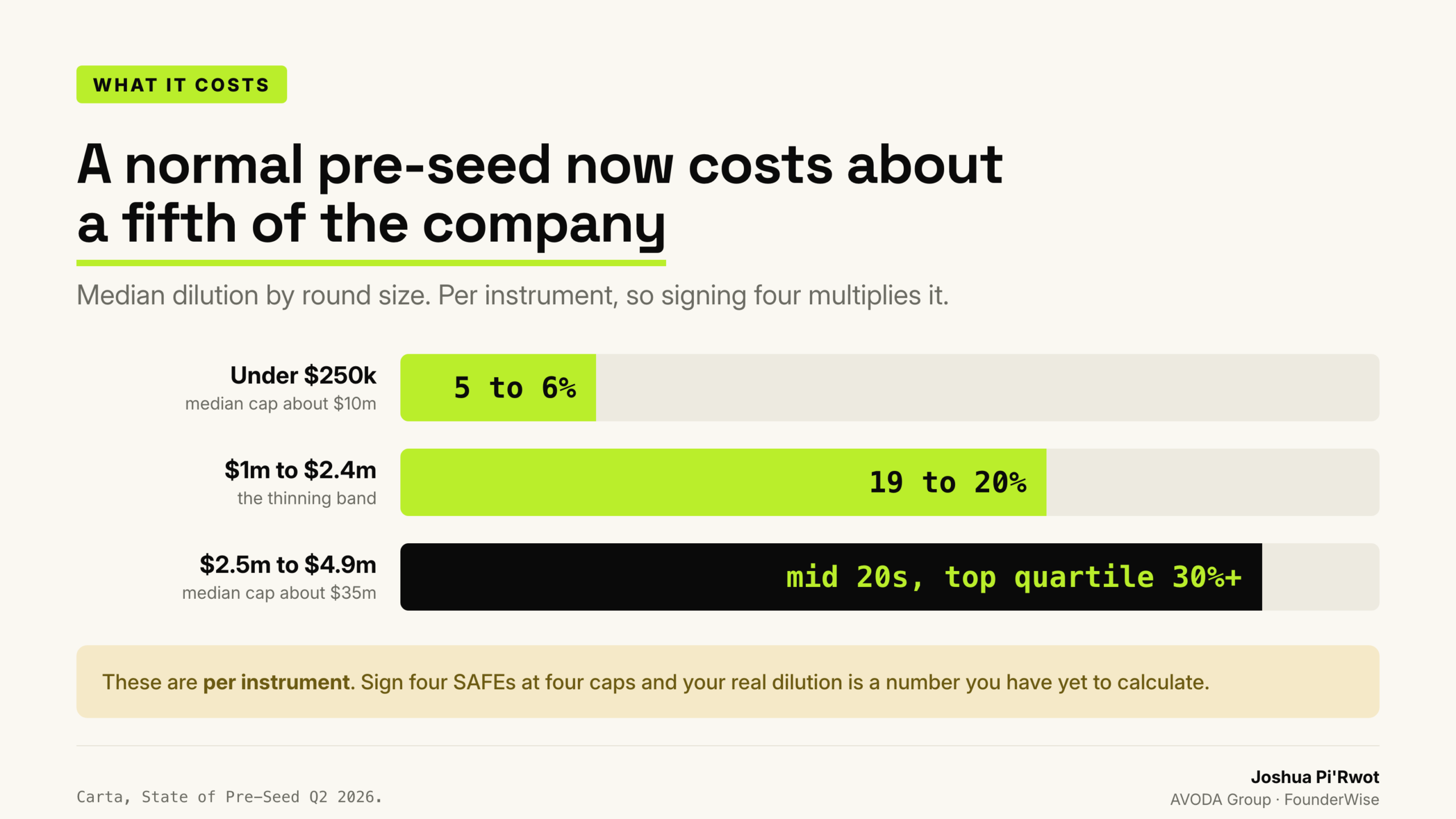
On Carta’s Q2 2026 data, median post-money SAFE valuation caps ran from about ten million dollars on rounds under 250,000, up to about thirty-five million on rounds above 2.5 million.
Dilution tracks in a way that surprises people. Under 250,000 dollars, median dilution runs around five to six percent. On a round between one million and 2.4 million, the median is around nineteen to twenty percent. Between 2.5 and 4.9 million it reaches the mid twenties, with the top quartile above thirty percent.
Say that plainly. A normal pre-seed now costs about a fifth of the company. A large one can cost a third, before a seed round has happened, before a Series A has happened, and before anyone has taken a board seat.
There is a tail to name here, because you will see it quoted at you. At the ninetieth percentile, caps on SAFEs above 2.5 million reach around a hundred million dollars. That is real and it is the edge of the market. Somebody will show you that number as though it described the middle of it.
The Word That Is Doing Quiet Work: Instrument
Go back to the headline figures. Look at the noun.
Carta counts instruments. An instrument is one SAFE or one convertible note, which makes it a different unit from a round and a very different unit from a company. A single pre-seed “round” is frequently several instruments, signed over months, at different caps, as the founder closes one angel at a time.
It matters in two directions, and both usually go unstated.
It makes the market look busier than it is
Eleven thousand five hundred instruments means far fewer than eleven thousand five hundred companies. If the typical raise involves three or four signatures, the company count behind that figure is a fraction of it. The twenty-two percent year-over-year fall is the real signal. The absolute level is a signature count, and quoting it as a company count is simply wrong.
It makes your own dilution hard to see until it is fixed
This is the expensive one. A founder signs 150,000 dollars at an eight million cap in February, another 200,000 at a twelve million cap in May, and 300,000 at a fifteen million cap in August. Each one feels small. Each one is small. They sit dormant until the priced round, then convert at once, each at its own cap. The founder meets the combined number for the first time in a spreadsheet the lawyers send at the worst possible moment.
The median dilution figures quoted earlier are per instrument. Sign four and your actual dilution is a number you have yet to calculate.
Build the conversion model before you sign the second SAFE, not after you sign the last one.
It takes an afternoon in a spreadsheet. Best hour of admin available to a pre-seed founder. Model the priced round at two or three plausible valuations and look at what you own afterward. If the answer shocks you, it is better to be shocked now, while the only cost is changing your plan.
The Odds Are Set Before You Start
This is the part I find hardest to say to founders, and the part that matters most.
Carta’s cohort data tracks what happens after a seed round, by the quarter in which the round closed. Roughly fifty percent of seed companies reach a Series A within sixteen quarters, four years. The companies that raised in the first quarter of 2019 hit 49.1 percent by that mark.
Go further out and the cohort effect becomes stark. Of the companies that raised seed since 2021, about fifteen percent reach a Series B within seven years. For cohorts that raised in frothier conditions, that figure was closer to thirty-two percent.
Two founders of identical quality, raising two years apart, face roughly double or half the odds of the same outcome. The difference is the year.
Take that as a reason to stop reading a rejection as a verdict on your business. A large share of the variance in how your fundraise goes is weather, and weather is impersonal.
It is also a reason to be extremely careful about what you conclude from other people’s outcomes. The founder who raised easily in 2021 and now dispenses advice is describing a different climate, in good faith, without knowing it.
What the cohort data should change about your plan
Half of seeded companies reach a Series A within four years. The median AI company takes 1.9 years. The seventy-fifth percentile takes about 3.4. So the planning assumption that a pre-seed buys a clean run at a seed in twelve months is wrong for most people.
Plan the raise you are doing now against the possibility that the next one takes twice as long as you expect. Usually that means the opposite of raising more, which costs equity you may never need to spend. Raise the smaller amount, keep the burn low enough that a long gap is survivable, and buy the option to be patient. Concentration punishes companies that need money on a schedule.
Three And A Half Minutes
Whatever you send gets read faster than you think. Much faster.
DocSend‘s research puts average investor review time on a seed deck at three minutes and forty-four seconds, and finds only fifty-eight percent of decks are read all the way to the final slide.
I want to flag something about that number rather than just quote it. DocSend has published at least three different figures for roughly this same thing: three minutes forty-four for seed, four minutes ten for pre-seed, and elsewhere “less than three and a half minutes” for pre-seed. I can find no reconciliation of the three anywhere. Treat the precise figure as soft.
What is firmer is the independent version. Papermark analyzed 3,000 pitch decks and found the first page received more than twice the attention of any other slide, with subsequent pages averaging about fifteen seconds each.
Two different companies, two different datasets, one conclusion: the deck gets three to four minutes, and the first slide does more work than the rest combined.
What that implies, concretely
Most founders put the thing that justifies the company on slide nine. Slide nine gets fifteen seconds. By then the reader has decided.
If the reason to believe you exists, it belongs on the first screen. Market size belongs further down, and so does the team photo. Put up the specific fact about you or your customers that a stranger would struggle to guess and struggle to dismiss.
Three Reasons To Distrust Everything Above
I want to answer these rather than leave them sitting.
“This is US data from a cap-table vendor”
Correct, and it is the strongest objection here. Every market figure above comes from Carta, which measures companies using Carta’s product: US-skewed, venture-track, institutional. It describes a slice of the world, and emphatically a different slice from the East African market I mostly work in. Uganda is absent from this dataset entirely.
So why does it matter to a founder in Kampala or Nairobi?
Because it is the reference class your investor is using. The people writing first checks increasingly price against these benchmarks even when the company in front of them looks nothing like the dataset. The numbers describe the yardstick rather than your business.
“Four sources all say the same thing, so it must be right”
Four sources here collapse into one. Nearly every figure in this article traces back to Carta. When four outlets publish the 276,000 dollar average instrument size, that is Carta once and three people reading Carta. I have tried to write “Carta’s data shows” rather than “the data shows” throughout, and I would ask you to hold anyone quoting these numbers to the same standard.
“Half of pre-seed dollars went to AI, so this is really an AI story”
Carta’s data does show AI companies taking about half of pre-seed dollars in 2026. But almost every startup now describes itself as an AI company, and Carta classifies by stated industry. The honest version is comparative rather than causal: half the dollars went to one self-declared category, so everything else competes for the other half. Whether AI caused the check count to fall is beyond what this data can show. The timing fits, and timing is weak evidence.
If You Are Raising From Kampala, Nairobi Or Kigali
Everything above describes a market most of my readers sit outside. Let me be exact about what carries across.
What fails to carry: the absolute numbers. A 276,000 dollar average instrument and a thirty-five million dollar cap describe a market with deep institutional pre-seed infrastructure. Here that infrastructure is thin, and pretending otherwise produces founders asking for terms every local investor will refuse.
What does carry, and this is the part to sit with: the direction of travel, and the yardstick. African startups raised somewhere between 3.2 and 3.9 billion dollars in 2025, depending on the tracker. Then in the first half of 2026, only 190 ventures on the whole continent raised 100,000 dollars or more. Lowest tally since at least 2021. Deals in the 100,000 to one million band fell forty-four percent in six months.
That is the same hollowed-out middle, in a much smaller market, with far less cushion.
The one adjustment I would make locally
In a market where the institutional first check is scarce, revenue is the funding strategy rather than a proof point. Every month of customer money buys you independence from a check the base rates say is unlikely to arrive. I say this to founders here more than anything else and it lands badly, because it sounds like a lowering of ambition. It is the opposite. It is the only version of this that keeps the ambition alive long enough to be tested.
Four Moves, In Order Of How Much They Change Your Odds
Four things, in order of how much they change your odds.
1. Price the round you can actually close
The one to 2.5 million band is the one that thinned. If you are raising 1.5 million because that is what the blog posts said pre-seed was, you are asking for the exact check that got rarer. A smaller round at a lower cap that closes beats a standard round that stalls. Under 250,000 dollars costs you five percent instead of twenty.
2. Put the believable thing first
Skip the market and the vision. Lead with the one fact a stranger would struggle to dismiss. You have the first slide and about fifteen seconds a slide after that.
3. Measure retention on a small base
Five hundred users with strong week-four retention beats five thousand churning out. It is also cheaper to produce and harder to fake, which is exactly why it reads as credible.
4. Separate the weather from the verdict
Keep a written record of why each conversation ended. After fifteen, you will be able to see whether you are hearing one consistent objection, which is information about your business, or fifteen different ones, which is information about the market.
This only works if it is written down at the time. Reconstruct it from memory three months later and you get a story about how the raise went rather than data about why. The story is always kinder. It is also useless.
The Money Stayed. The Patience Went.
The money stayed. Roughly three billion dollars a quarter still goes into pre-seed in the US alone. What changed is that it stopped being spread thinly, and the ordinary round became the hard one to raise.
In one way that is worse than a downturn, because waiting it out fails as a strategy. In another it is better, because concentration responds to evidence.
You are not raising in a market with no money. You are raising in a market with no patience.
You are ready to raise if:
you can name the one fact about your customers that a stranger could not have guessed, and you can put it on the first screen.
You are not ready if:
your strongest argument is the size of the market. Everyone raising this quarter has that slide, and it is the one nobody reads past.
If you want to know where you stand before thirty-one investors tell you, that is what I built FounderWise to do. A short assessment, a score, the weakest category named rather than the nicest one, and a short list of the calls to make this week. Free to start, no card, one email link: app.founderwise.io
If you would rather talk your numbers through with me first, book a strategy call.
Advice is free. Being wrong about this costs a year of runway.
Josh
Sources
- Carta, State of Pre-Seed Q2 2026
- Carta, State of Pre-Seed Q1 2026
- Carta, State of Pre-Seed 2025
- Carta, graduation rate from seed to Series A
- DocSend (Dropbox), pitch deck research
- Papermark
- TechCabal Insights, six things we learned about African tech in 2025
- Africa: The Big Deal, H1 2026 deal sizes
- AVCA, Q2 2026 Venture Capital in Africa report