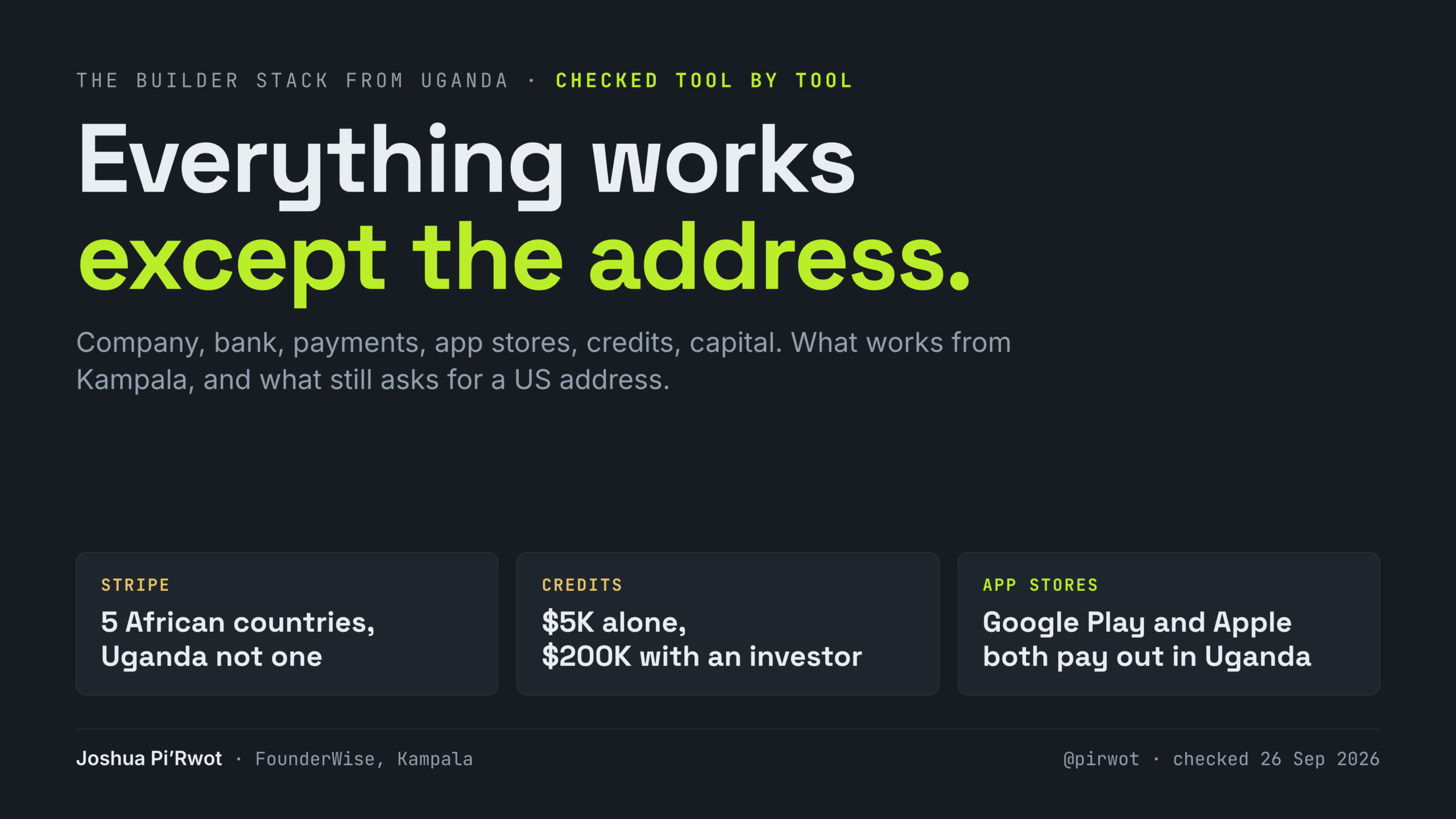
A founder in Austin can form a company, open a bank account, take card payments and claim cloud credits in about a week. I have run founder programs in Uganda for nine years, and this year I built FounderWise from Kampala on top of that same stack. So I went through it one step at a time and checked what actually works from here.
I read each provider’s own pages on 26 September 2026. Rules like these change often, so treat every line below as a snapshot of that day. Where I could only find a secondary source, I say so.
FounderWise, LLC is a Delaware company, formed on 29 May 2026. We have Stripe through that company. We have no physical presence in the United States. This year a US card provider declined us for exactly that reason, and later our bank froze our card. Both decisions were reasonable by the rules each company publishes. MVP Studio, our first product, went live on 25 September. Seven founders signed up in the first three hours. Revenue so far is zero.
Here is the journey, in the order a founder meets it.
Step one: incorporate
This part works. Stripe Atlas forms a Delaware C corp or LLC for $500 and says it serves startups in over 175 countries. The package includes the EIN, the 83(b) filing, a registered agent for the first year, $2,500 in Stripe credits and about $50,000 in partner perks. Clerky charges $427 and files the EIN by fax for founders without a US taxpayer ID.
The first friction shows up in the tax ID. Stripe’s own guide says an EIN takes 1 to 15 business days if you have a US address, a US phone number and an SSN. Missing any of those three, “the IRS could take 15 to 50 business days.” A Ugandan founder is usually missing all three. So the company exists on day two, and the number that lets it do business can take two months.
Locally, a law-firm guide puts registering a private company with the Uganda Registration Services Bureau at UGX 300,000 to 700,000 all in. An operating license takes about 7.1 days here, against 17.6 across sub-Saharan Africa, per the World Bank’s 2025 Enterprise Survey.
Paperwork is the easy part.
Step two: open a bank account
Here the US stack starts asking where you are.
Stripe Atlas advertises “pre-EIN banking and payments” through Stripe Treasury, “if eligible.” Since 1 July 2025, Stripe requires a physical US presence for its Treasury, Issuing and Opal accounts. For Atlas companies, Stripe says the evidence “can’t be your Atlas registered agent.” That one sentence closes the default banking path for most founders outside the US.
The US corporate card and banking providers have similar rules, stated plainly. Ramp asks for “most of your operations and corporate spending in the US,” a physical US address that cannot be a PO box, virtual office, registered agent or mail-forwarding address, $25,000 in a US business bank account, and an EIN. Brex requires “a US EIN issued by the IRS, a valid US incorporation, US operations, and a US physical address.” Airwallex lists zero African countries as eligible for business onboarding. A Delaware company could apply to Airwallex as a US business, subject to its own checks.
Now the part people miss. Uganda sits off the banned lists I checked. Relay’s prohibited-country list names thirteen African countries, including Burundi, DRC, Ethiopia, Nigeria and South Sudan. Uganda is absent from it, and Relay says it permits US entities with non-US owners and businesses based internationally. Paddle‘s unsupported list is the same story: several neighbors appear, Uganda does not.
So the question these providers ask is where you operate, and your passport is a smaller part of it. That distinction matters, because an operating footprint is something a company can build.
Wise supports the shilling and leaves Uganda off its unsupported list, though it publishes only a negative list for businesses. I would call it worth trying and unproven for a Ugandan-registered company.
Step three: take payments
Stripe’s global page lists five African countries: Cote d’Ivoire, Ghana, Kenya, Nigeria and South Africa, all through its “extended network,” which is Paystack. Uganda is absent. Paystack itself says its services are available “only to businesses registered in Nigeria, Ghana, South Africa and Kenya.”
That is why so many founders here form a Delaware company, and it is why I did. Stripe’s general rule for a US account asks for “a physical location in that country where you can receive mail, not a P.O. box.” A card-accepting Stripe account and the stricter Treasury and Issuing rules are different gates. We have the first. The second is what the July 2025 change tightened.
PayPal is murkier. Its Uganda homepage markets sending money and shopping. Its user agreement says receiving is offered “where available” and that service availability varies by country. Many Ugandan sources report that local accounts can send but cannot receive. PayPal’s public pages stop short of saying so, so treat it as a local report.
The local rails, meanwhile, are real and they work. Mobile money is the account most Ugandan adults actually have: the World Bank’s Global Findex puts mobile money accounts at 67.7% of adults, against 26.2% with a bank or similar account. Flutterwave is licensed in Uganda and publishes its fees: 3.2% on local cards, 4.8% on international cards, 3.0% on mobile money collections. Local settlement takes 24 hours. Pesapal also takes Visa, Mastercard, Amex and mobile money in shillings and dollars. I could not find its published rates, so ask them directly.
Those fees are a real cost of doing business. The rails are also real rails.
Step four: get paid by the app stores
This was the best news in the whole exercise.
Google Play supports both developer and merchant registration from Uganda, with a default currency of US dollars. Rwanda, for comparison, has developer registration only. A Ugandan developer can sell apps and in-app purchases and get paid.
Apple lets an organization enroll in its Developer Program with a D-U-N-S number, which is free. Dun & Bradstreet takes up to five business days to issue it and Apple takes about two more, so plan on roughly a week. Trade names and DBAs are refused, so use the legal name. On payouts, Apple’s minimum-payment table lists Uganda with a UGX threshold, which means App Store proceeds can land in a Ugandan bank account. Several other African banks default to a 40 USD threshold instead.
If you are building a mobile product, the two biggest app stores in the world will pay you in Kampala. I think that deserves more airtime than it gets.
Step five: sell online
Shopify Payments works in 38 countries, and none of them are in Africa. A Ugandan store can still run on Shopify. It needs a third-party payment gateway, which in practice means one of the local processors above.
For digital products, the merchant-of-record services split. Paddle supports sellers in Uganda. Lemon Squeezy pays out to bank accounts in 79 countries, including Kenya, Tanzania, Rwanda, Ethiopia, Nigeria, Ghana and South Africa, and Uganda is missing from that list. Its fallback is PayPal, which runs straight back into the receiving question above.
So Paddle is the one I would try first for software.
Step six: cloud credits
The cloud programs rarely check your country. They check who vouches for you.
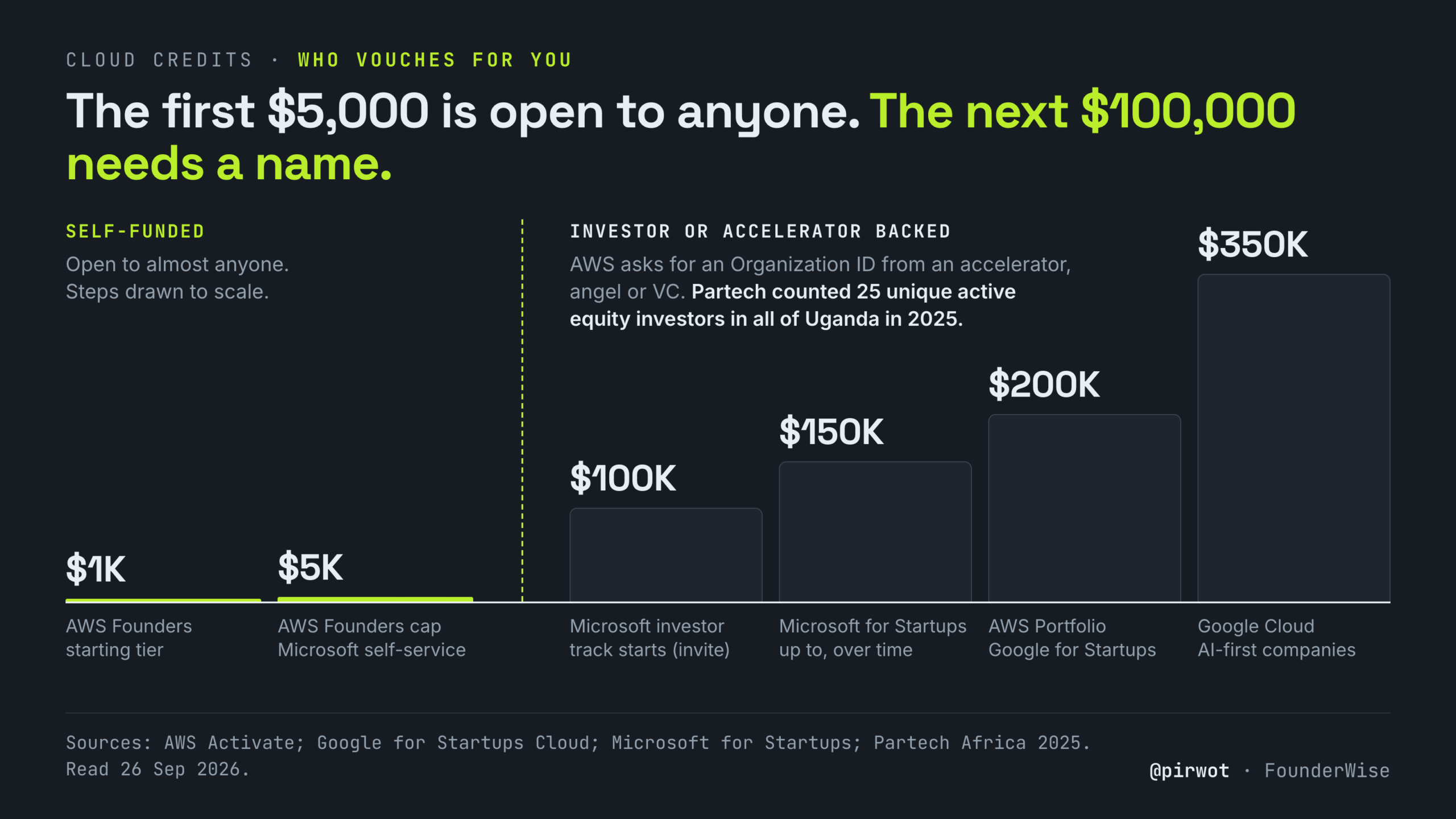
AWS Activate‘s Founders tier is open to self-funded startups and runs up to $5,000, starting at $1,000. The Portfolio tier goes up to $200,000, and it needs “an Organization ID from your Activate Provider, such as an accelerator, angel investor, and venture capital firm.” Google for Startups Cloud offers up to $200,000, or $350,000 for AI-first companies, tied to institutional equity funding, with SAFEs counted. Microsoft for Startups says up to $150,000 over time for companies headquartered where Azure is available, with a self-service path up to $5,000 and an invite-only investor track that starts at $100,000.
So the first $1,000 to $5,000 is open to almost anyone. The next $100,000 or more depends on an investor or accelerator name being attached to you. In Uganda, the Partech 2025 report counted 25 unique active equity investors in the whole country. That is a short list of people who can hand out an Organization ID.
Step seven: raise on a SAFE
The standard early-stage instrument in the US is the Y Combinator post-money SAFE. It is written for Delaware companies. YC also publishes versions for Canada, the Cayman Islands and Singapore. A Ugandan company that wants to raise on standard US paper either becomes a Delaware company or uses local instruments that US investors may find unfamiliar.
This is one reason the Delaware route is so common. Briter‘s Venture Pulse report from August 2026 found that half of all African startup funding in the first half of 2026 went to companies incorporated outside Africa.
The size of the pool matters too. Partech counted $22 million raised by Ugandan startups in 2025, about half of one percent of Africa’s $4.1 billion. The US invested $412.7 billion in the first half of 2026 alone, per PitchBook-NVCA.
Step eight: borrow
US founders rarely need debt at seed, because equity is plentiful. When they do, an SBA 7(a) loan is capped at roughly 9.75% to 13.25%, from the September 2026 prime rate plus the SBA’s allowed spread.
In Uganda, the Bank of Uganda held its policy rate at 9.75% on 13 August 2026. Commercial shilling lending ran from 18.73% in February 2026 to 16.9% in June, the lowest since April 2025. That is roughly one and a half to two times the SBA cap, before collateral requirements.
Then there is the credit file. The last year the World Bank measured it, 2019, private credit bureaus covered 6.9% of Ugandan adults. In the US the figure was 100%. The series ended in 2021, so I cannot give a current number, and Uganda has licensed more bureaus since. Still, a lender here usually starts with very little to read about you.
A loan is priced on what a lender can see.
Step nine: pay for your tools
Once the company exists, every SaaS subscription is a small cross-border payment with taxes attached. These figures come from press and tax-advisory reports, and I have not read them in the Uganda Revenue Authority’s own text, so check them before you rely on them.
Uganda charges 18% VAT on imported digital services. A 5% digital services tax on non-resident providers took effect in July 2023, and from 1 July 2025 it was reportedly replaced by a 15% final withholding tax on non-resident digital service income. Moving money adds a 0.5% excise on mobile money withdrawals, on top of excise on telecom fees. The Treasury dropped a plan to halve the withdrawal levy in April 2026. The Daily Monitor worked out that withdrawing UGX 1 million by mobile money costs about UGX 16,630, against roughly UGX 3,000 at an ATM.
Currency adds a moving target. The shilling traded around 3,644 to the dollar on 20 June 2026 and around 3,937 on 19 September, and the Bank of Uganda raised the cash reserve requirement to 13.5% that month to defend it. A $50 monthly tool cost about 8% more in shillings in September than it did in June.
Step ten: connectivity and power
The stack assumes the lights stay on and the connection holds.
The ITU’s 2025 price data puts a 5GB fixed broadband basket at 33.98% of monthly income per person in Uganda, against 0.76% in the US. A 2GB mobile data basket is 3.03% of monthly income here, above the UN Broadband Commission’s 2% target, and 0.61% in the US.
On power, 79.9% of Ugandan firms experienced outages in the World Bank’s 2025 Enterprise Survey, against 22.6% of US firms in 2024. After the state utility UEDCL took over distribution from Umeme in April 2025, its own acting managing director told Parliament that outages had almost doubled and average restoration time had risen from about 12 hours to nearly 20.
And sometimes the internet is switched off. The regulator ordered public internet suspended from 6pm on 13 January 2026, two days before the general election. General access returned about 100 hours later, and social media stayed blocked until 26 January. CIPESA estimated the loss at UGX 59.7 billion, about $16 million, and other estimates vary.
So I save work to disk every hour and keep offline copies of anything I need to ship. It is a cheap habit.
The stack at a glance
Here is the whole stack on one page, grouped by setup step, with each tool’s status from Uganda on 26 September 2026.
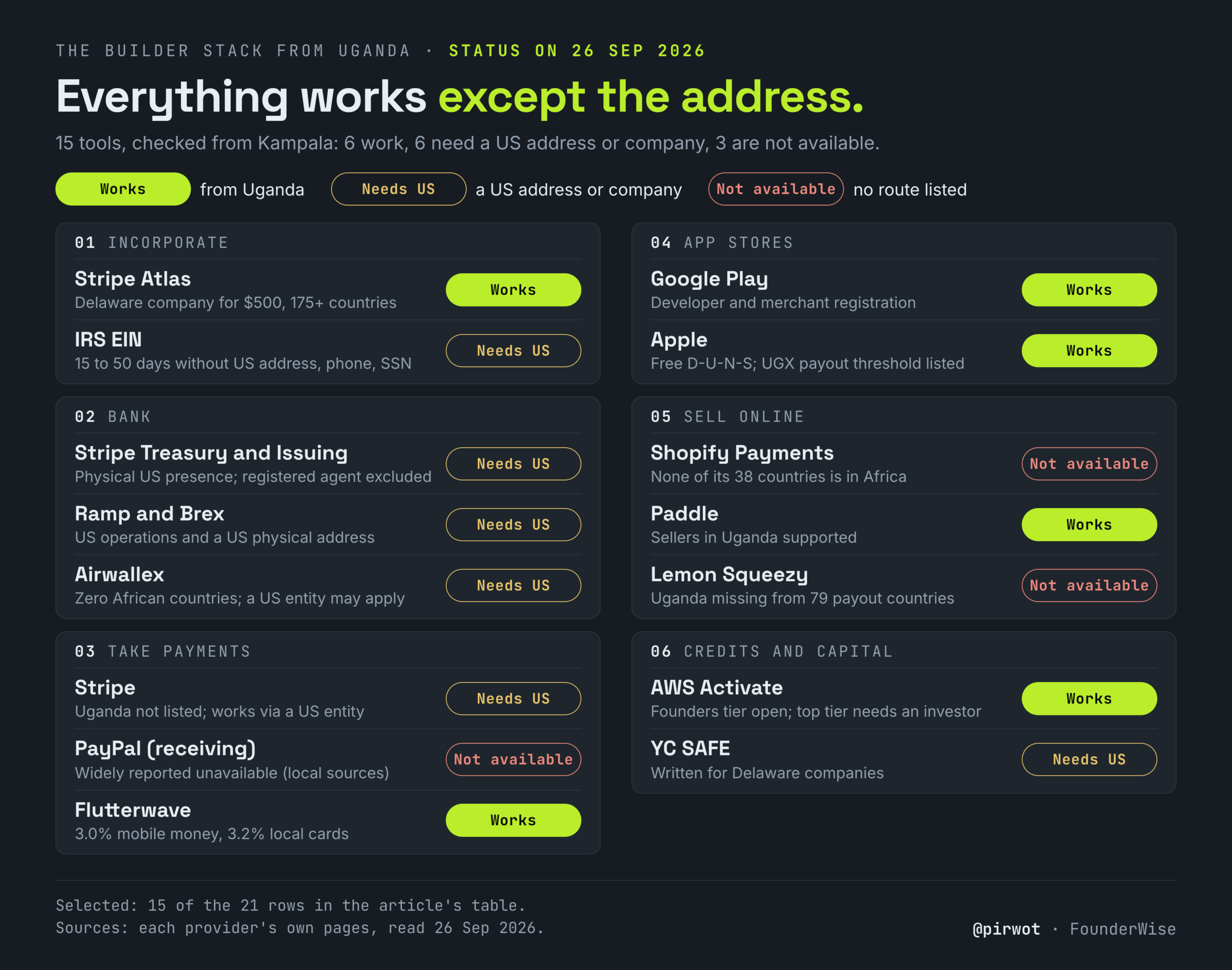
| Step | Tool | What a US founder gets | Uganda status (26 Sep 2026) |
|---|---|---|---|
| Incorporate | Stripe Atlas | Delaware company, EIN, registered agent, $2,500 credits, $500 | Works for formation, 175+ countries |
| Incorporate | IRS EIN | 1 to 15 business days | 15 to 50 business days without US address, phone and SSN |
| Bank | Stripe Treasury and Issuing | Banking and cards through Atlas | Needs a physical US presence; registered agent address excluded |
| Bank | Ramp | Corporate card | Needs US operations, US address, $25,000 in a US bank |
| Bank | Brex | Card and cash account | Needs US operations and a US physical address |
| Bank | Relay | Business banking | Uganda absent from the prohibited list |
| Bank | Airwallex | Multi-currency account | Zero African countries eligible; a US entity may apply |
| Payments | Stripe | Full home-market account | Uganda unsupported; works through a US entity |
| Payments | PayPal | Send and receive | Send works; receiving widely reported unavailable (local sources) |
| Payments | Flutterwave | n/a | Works: 3.2% local cards, 4.8% international, 3.0% mobile money |
| App stores | Google Play | Developer and merchant account | Developer and merchant registration supported |
| App stores | Apple | Org enrollment, bank payouts | Free D-U-N-S, about 7 days; UGX payout threshold listed |
| Sell online | Shopify Payments | Native checkout | Unavailable in all of Africa; use a third-party gateway |
| Sell online | Paddle | Merchant of record | Uganda supported |
| Sell online | Lemon Squeezy | Bank payouts, 79 countries | Uganda missing; PayPal fallback |
| Credits | AWS Activate | $1,000 to $200,000 | Founders tier open; top tier needs an accelerator or investor ID |
| Credits | Google and Microsoft | Up to $150,000 to $350,000 | Top tiers tied to investor backing |
| Raise | YC SAFE | Standard paper | Written for Delaware; Ugandan companies flip or go local |
| Borrow | SBA 7(a) | About 9.75% to 13.25% | Shilling loans 16.9% to 18.7%; bureau coverage 6.9% (2019) |
| Tools | Taxes and FX | Card works, sales tax only | 18% VAT on digital imports, 0.5% mobile money levy, shilling swings (press) |
| Infrastructure | Broadband and power | 0.76% of income; 22.6% of firms hit by outages | 33.98% of income; 79.9% of firms hit by outages |
What the pattern says
When I lay the rows side by side, a pattern shows up. Very few of these tools refuse Uganda by name. Stripe, Paystack, Shopify Payments and Lemon Squeezy leave Uganda off their country lists. Almost everything else that stops a Ugandan founder is asking for a US address, US operations, or a recognized name on your cap table.
Those are all trust signals. An address tells a card issuer someone can be found. A credit file tells a lender what you did last time. An investor’s Organization ID tells AWS that someone has already checked you. Each tool is asking the same question in its own words: can we trust you without meeting you?
That makes the gap narrower than people think. You can get a company, a payment processor, two app store accounts, a merchant of record and a few thousand dollars of cloud credits. It also makes the gap deeper than it looks, because the missing piece is the part that compounds. The address unlocks the card, the card builds a history, the history unlocks the credit, and the investor name unlocks the large credits and the next round.
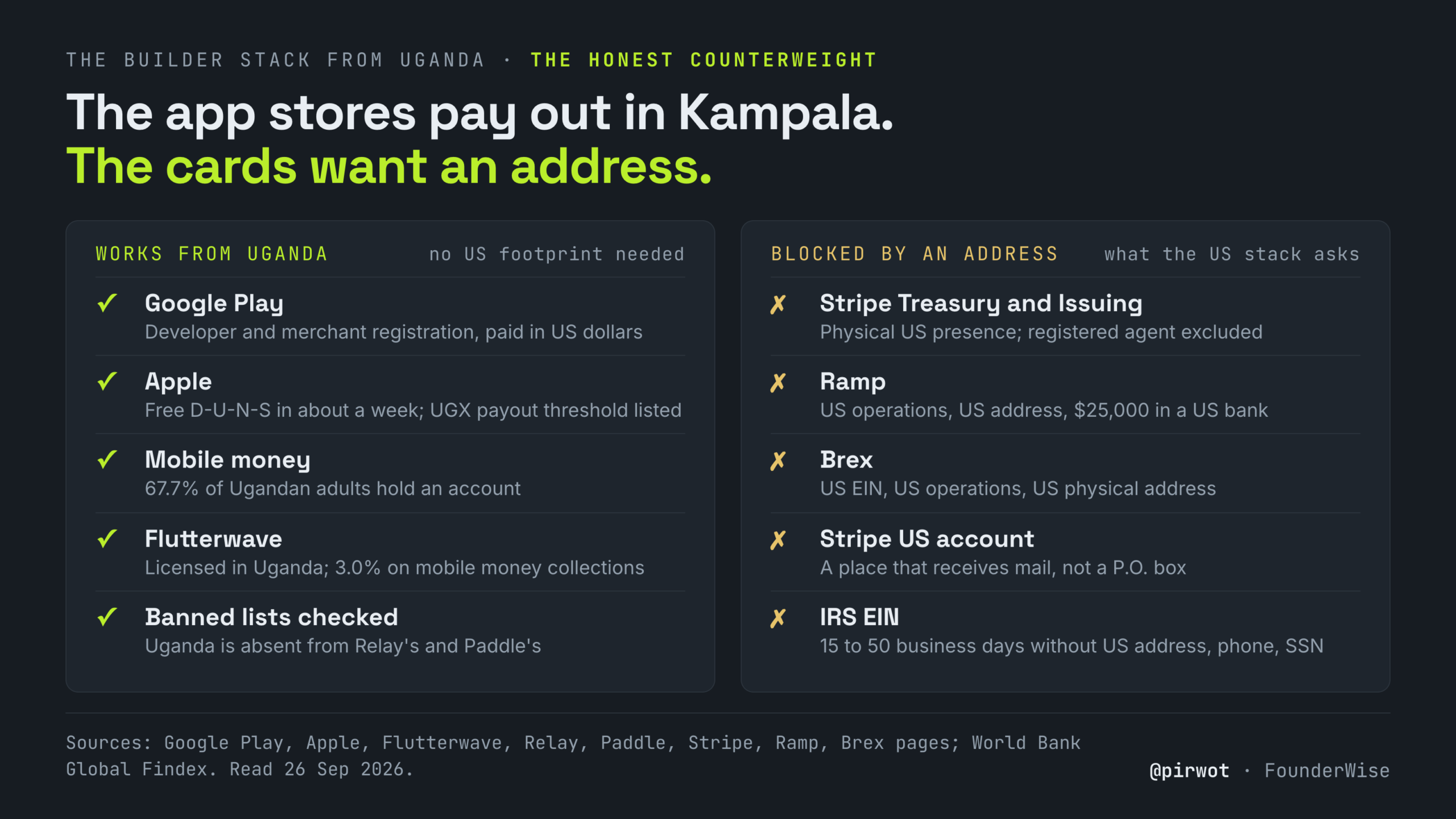
An address and a trust signal are solvable problems. Some of the solving is paperwork and money. Some of it is simply keeping an honest record of your work that someone far away can check.
What I would set up first, in order
This is my opinion, based on my own year and on nine years of working with founders here. Your product and market may call for a different order, and I may have missed tools that work fine from Uganda.
- Register locally with URSB and open mobile money and bank accounts. Your first customers are probably here, and mobile money is how most of them pay.
- Set up a local processor such as Flutterwave. Price the 3% to 4.8% into your product from day one.
- Build the product and get real paying users before you form abroad. Seven signups in three hours taught me more than any form I filled in this year.
- If you build mobile, open Google Play and Apple accounts early. Request the free D-U-N-S number now, since it takes about a week.
- Start with the self-serve cloud credits. Take the AWS Founders tier and Microsoft’s self-service tier, and save the large tiers for later.
- Form a Delaware company when a US customer, investor or processor actually requires it. Expect the EIN to take weeks, and budget for it.
- Solve the US address properly before applying for US cards or banking. A registered agent address will be rejected. Apply once you can pass.
- For software sales, try Paddle before the PayPal-dependent options.
- Keep a written record of everything: customers, payments, product tests. This is what lenders, programs and investors eventually ask for, and it is the hardest thing to rebuild later.
- Checkpoint your work to disk every hour and keep an offline plan for shutdown weeks.
Where FounderWise fits
That ninth item is the problem I am working on. MVP Studio helps a founder plan, test and record an MVP, so the evidence of real progress exists in a form someone else can read. It went live on 25 September, and it is free to start at app.founderwise.io/mvp. If you are working through any step above and want a second pair of eyes on the order, I take strategy calls at cal.com/pirwot/strategy-call.
If you build from East Africa, which tool in your stack would you tell a new founder to set up first?
Sources
All pages read on 26 September 2026. Provider eligibility rules change often, so check the live page before you act.
- Stripe global availability
- Paystack availability
- Stripe Atlas
- Stripe physical presence FAQ
- Stripe guide to US bank accounts and EIN timing
- Ramp US eligibility
- Brex requirements
- Relay prohibited countries
- Airwallex eligible countries
- PayPal Uganda user agreement
- Flutterwave Uganda
- Google Play supported locations
- Apple D-U-N-S
- Apple minimum payment threshold
- Shopify Payments countries
- Paddle supported countries
- Lemon Squeezy supported countries
- AWS Activate
- Google for Startups Cloud
- Microsoft for Startups
- YC documents
- Briter Africa Venture Pulse 2026
- Partech Africa 2025
- PitchBook-NVCA Q2 2026
- Bank of Uganda rate hold
- Uganda lending rates
- SBA loan rates
- World Bank Global Findex
- World Bank power outages indicator
- ITU ICT price baskets
- Uganda digital tax change
- Mobile money levy
- UEDCL outages
- 2026 shutdown impact