Every few weeks someone posts that African AI is having a moment. The company count is up, the demo days are full, and the headline funding numbers are rising again after a bad couple of years.
All of that is true. Here is the number underneath it.
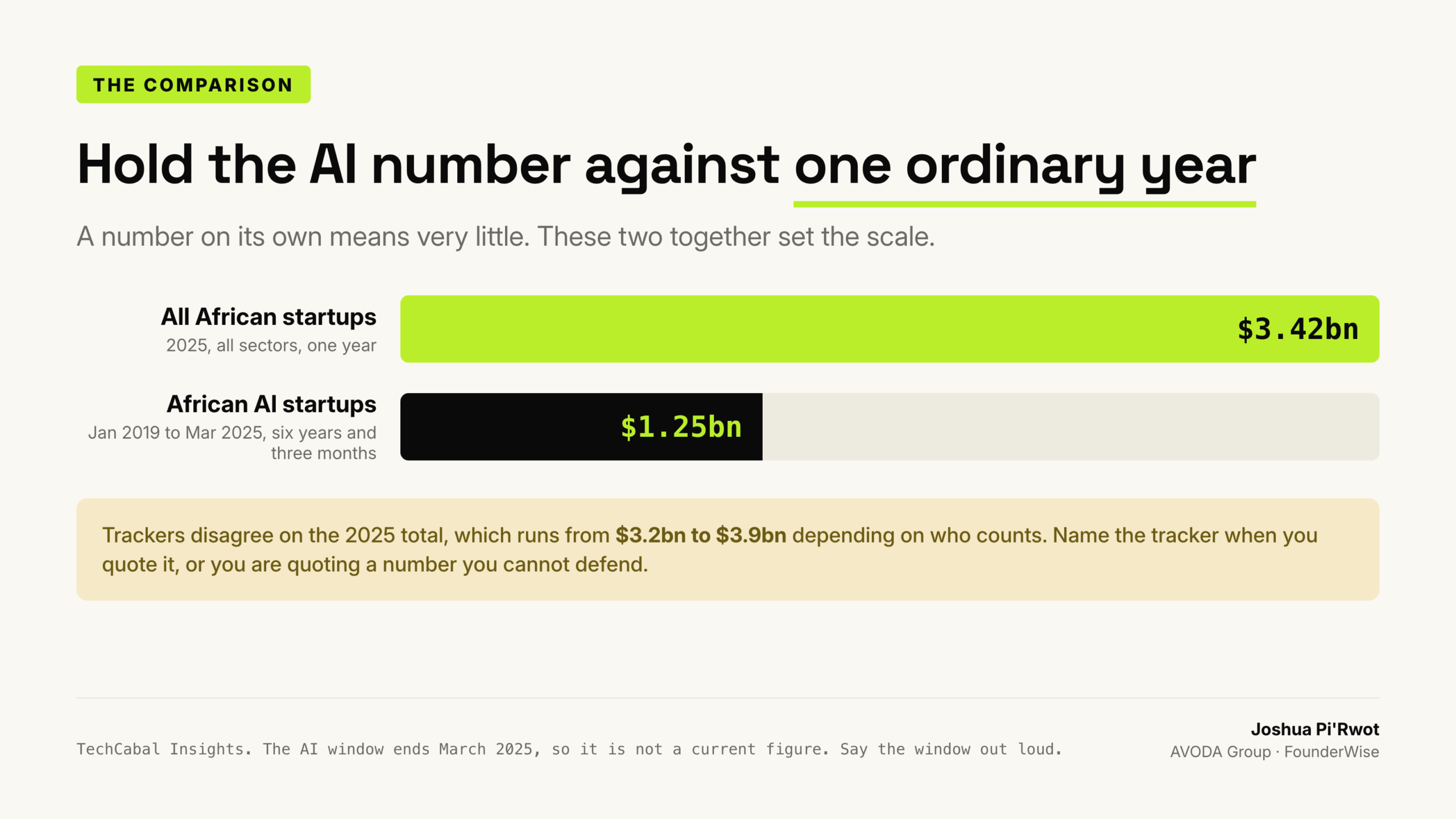
African AI startups raised about 1.25 billion dollars in total between January 2019 and March 2025. Not in a year. In six years and three months, across the entire continent, for the whole sector.
One American lab routinely raises more than that in a single round.
Six years of AI funding for an entire continent is about a third of one good year across all its sectors. That is the actual size of the wave.
The Comparison That Sets The Scale
Hold that 1.25 billion against two other figures, because a number on its own means very little.
Against one year of everything
African startups across all sectors raised somewhere between 3.2 and 3.9 billion dollars in 2025, depending on which tracker you use. Take the most commonly quoted figure, 3.42 billion.
So six years of AI funding for the continent is roughly a third of twelve months of funding across every sector on the same continent. That is the size of the thing people are calling a wave.
Against a single company elsewhere
I will leave a specific lab’s round out of it, because those numbers move monthly and the comparison is cheap. The general shape is enough: individual AI companies in the US have raised multiples of the entire African sector’s six-year total, and several have done it in a single financing event.
Treat that as a measurement. It should change what you plan rather than how you feel.
Twice The Companies, Not Twice The Money
The census figure is the one I find most revealing.
TechCabal Insights tracked 207 African AI startups in 2025, up from 104 in 2022. The number of companies doubled in three years.
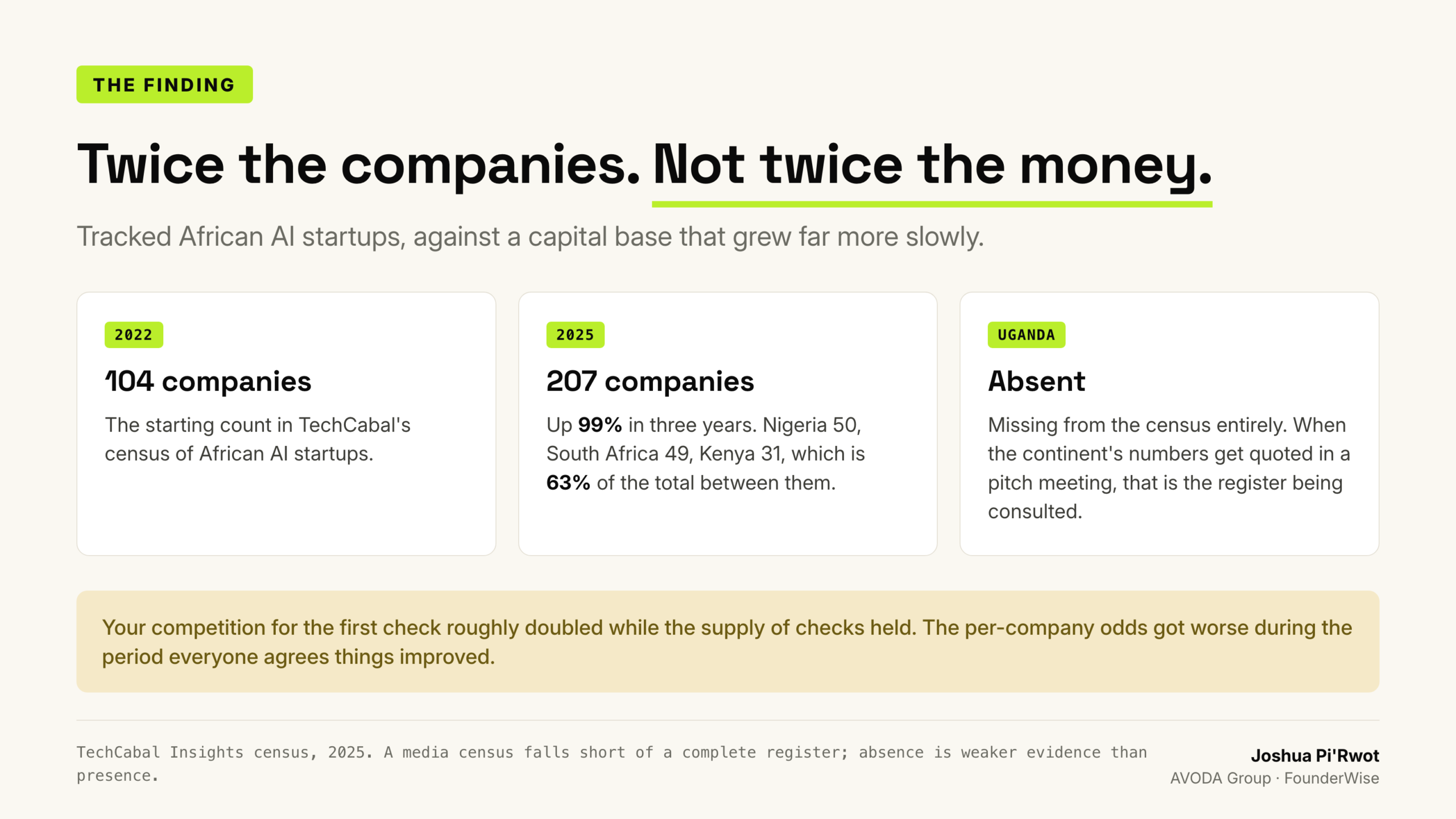
Set that against a capital base that grew far more slowly. More founders competing for a pool that stayed roughly flat describes an ecosystem getting more crowded at the bottom. That produces exactly the surface signals people read as health: more companies, more demo days, more announcements, more noise.
What that means for a specific founder
Your competition for the first check roughly doubled while the supply of checks held. The per-company odds got worse during the period everyone agrees things improved. Both statements come from the same dataset.
Where The Companies Actually Are
Nigeria hosts 50 of the tracked AI startups, South Africa 49, Kenya 31. Those three account for 63 percent of the total.
Uganda is absent. Missing from the list rather than low on it.
That deserves careful reading rather than outrage. A census of 207 companies assembled by a media organization falls well short of a complete register, and absence from it is weaker evidence than presence in it. But I have gone looking for Ugandan companies in several of these datasets over the past year. The pattern holds. We are usually missing. And when the continent’s numbers get quoted in a pitch meeting, that is the register being consulted.
The practical version of that problem
If your market is missing from the datasets investors read, you are competing against Nigerian and Kenyan visibility rather than against Nigerian and Kenyan companies. That is a different and harder contest.
The answer is to carry your own evidence into the room. The ambient context that does half the work for a Lagos founder does none for you, and complaining about the census will not change that.
Three Trackers, Three Numbers, One Half-Year
Anyone who follows this closely knows the next problem, and everyone else should.
For the first half of 2026, Africa: The Big Deal counted 1.36 billion dollars, down six percent year over year. Other trackers count the same six months and get different totals. TechCabal Insights reports a stronger picture: around 705 million dollars in Q1 alone across 59 deals, up 26.5 percent year over year, and roughly 1.3 billion by early June.
Those readings resist being folded into a single story, for definitional rather than dishonest reasons. Each tracker draws the boundary somewhere else. Does a debt facility to an infrastructure company count as startup funding? Does a pan-African company headquartered offshore count as African? What is the minimum disclosed round size?
If someone quotes you an African funding number without naming the tracker, they do not know what they are quoting.
This is more than pedantry. The same six months reads as a recovery or a decline depending on the source you pick. Both versions are in circulation right now.
How I handle it in practice
Name the tracker in the sentence. “Africa: The Big Deal counted 1.36 billion in H1 2026” is a defensible claim. “African startups raised 1.36 billion in H1 2026” fails, because it implies a precision and a consensus that the trackers themselves lack.
The Middle Went Missing Here Too
The most consequential African number this year is a count rather than a total.
In the first half of 2026, only 190 ventures on the entire continent raised 100,000 dollars or more. The Big Deal describes that as the lowest tally since at least 2021.
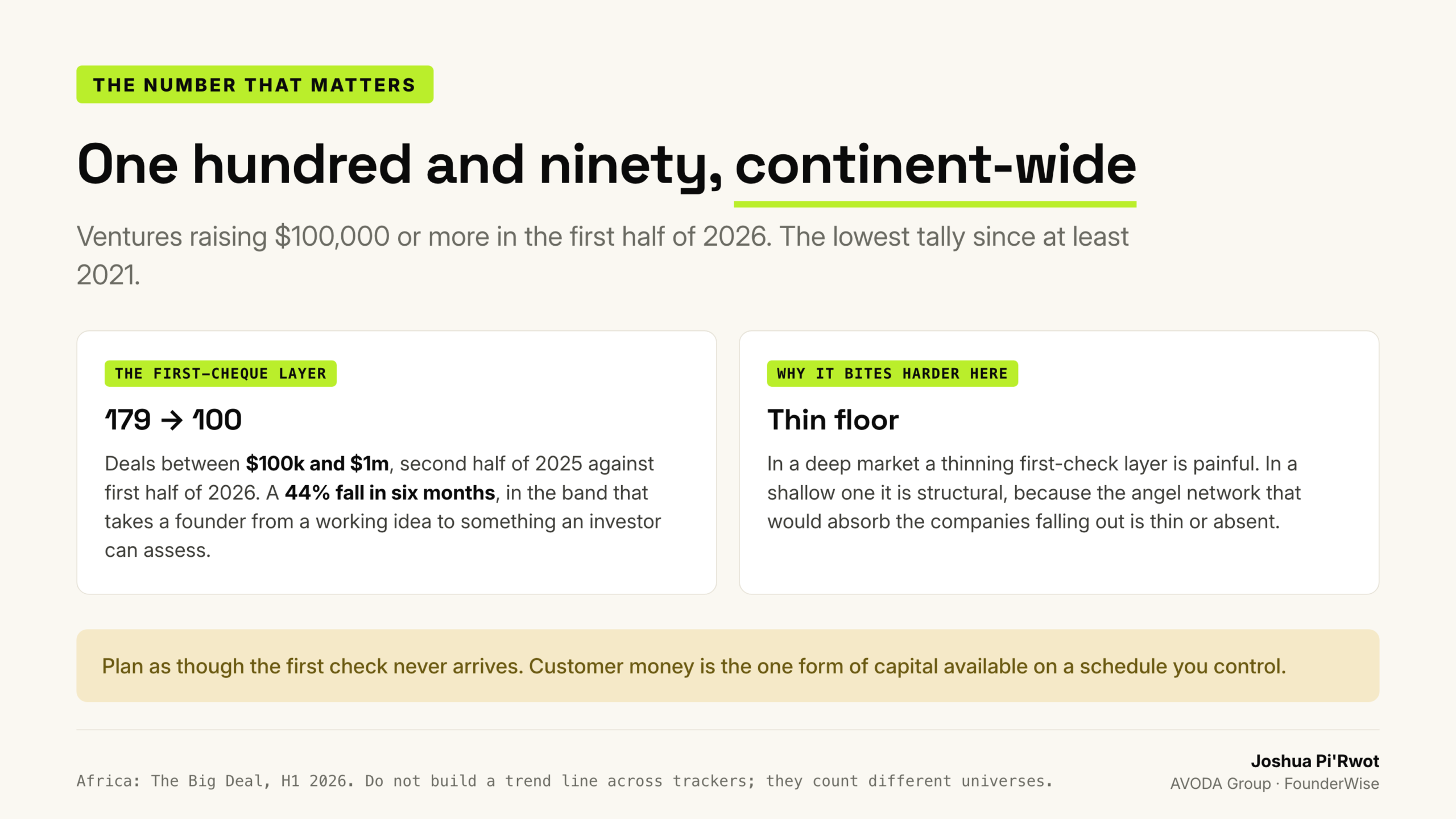
And within that, deals between 100,000 and one million dollars fell from 179 in the second half of 2025 to 100 in the first half of 2026. A 44 percent fall in six months, in the band that does the most work for early companies.
That is the first-check layer. That money takes a founder from a working idea to something an investor can assess. On the continent with the thinnest alternatives, it is the band that contracted hardest.
Why concentration is worse here
In a deep market, a thinning first-check layer is painful. In a shallow one it is structural, because the dense angel network that would absorb the companies falling out is thin or absent. When the institutional small check disappears in Kampala, the floor below it is often bare.
The Honest Counter-Argument
Let me argue against myself properly here, because the easy version of this article is a grievance and the grievance misses.
Small absolute numbers can be perfectly reasonable. African AI companies are younger, serve smaller domestic markets, and in most cases need far less capital per company to reach usefulness than a lab training foundation models. A two million dollar company solving a real distribution problem in Nairobi may be a considerably better business than a two hundred million dollar one training a model nobody asked for.
Capital raised is an input. We keep scoring it as an achievement. A decade of treating funding announcements as results produced the failure cluster of the past two years: capital-intensive companies that bought market share with venture equity and then ran out. That is the bill arriving. It is still being paid.
The argument is about size, not fairness. This is the actual pool, so price your plans to it.
Four Things Follow, And None Is About Fundraising
Four things follow, and all of them are about operations.
1. Plan as though the first check never arrives
Treat that as planning rather than pessimism. 190 companies continent-wide cleared 100,000 dollars in six months. Run the base rate for any one company. A plan that depends on institutional money is a plan that depends on an unlikely event. Build the version that works without it, and treat a check as acceleration rather than as the mechanism.
2. Revenue is the funding strategy
This is the sentence I repeat most often and it consistently lands badly, because it sounds like lowered ambition. It is the opposite. Customer money is the one form of capital available on a schedule you control, in a market where the alternative reaches roughly one company in a thousand. Every month of it buys you the right to still be here when conditions change.
3. Carry your own evidence
If your country is missing from the census, the room arrives with no prior about you, good or bad. That is recoverable by bringing numbers specific enough to be legible without a national context: retention, repeat purchase, unit economics, named customers.
Dated is what makes them evidence. A retention figure with a date attached, tracked across six months, is an argument. The same figure quoted from memory in a meeting is a claim, and claims from uncounted markets get discounted by default. Build the record before you need it, because the moment you need it is too late to have been keeping it.
4. Read the tracker before the headline
When a funding number is used to justify a decision, find out who counted and what they counted. On this continent that single habit will separate you from most of the people in the conversation.
Three Ways This Argument Could Be Wrong
“These trackers undercount everything, so the picture is wrong”
Probably true, and I would go further. Undisclosed rounds, grant funding, diaspora money and informal investment all get missed. Those are disproportionately what early African companies actually run on. The real capital flow is larger than 1.25 billion.
But the undercount is roughly consistent year to year, so the comparisons and directions hold even where the levels mislead. And critically, the undercounted money is invisible to the people making allocation decisions, which means the published figure is the one shaping behavior whether or not it is accurate.
“You are comparing a six-year African total to a single American round, which is rhetoric”
It is a rhetorical device and I have used it deliberately, so let me defend it. The comparison is fair for one specific purpose: calibrating what “a wave” means before you make plans on the strength of it. It would be unfair used two other ways. To argue African AI is a poor place to build, which is the opposite of my claim. Or to argue the gap says something about the founders, which it plainly does not.
“Things are improving, and this reads as discouraging”
The direction genuinely is better than 2023. My concern is narrower. A founder who reads the improving headline and plans for the improving headline will raise their burn ahead of a capital supply that has not actually arrived in the band they need. The rising number is real, and so far it is arriving as larger later rounds rather than first checks.
The Real Dimensions, Stated Plainly
One and a quarter billion dollars over six years and three months. Two hundred and seven companies where there were a hundred and four. One hundred and ninety ventures continent-wide clearing a hundred thousand dollars in a half-year, the fewest since at least 2021.
Those are the real dimensions. They are a reason to plan differently. I am still building here.
Build as though the check is not coming, because for roughly everyone, it is not. The ones who get funded here are mostly the ones who did not need it by the time it arrived.
You are reading this correctly if:
it changes your burn rate and your revenue plan.
You are reading it wrongly if:
it changes how you feel about the ecosystem. The numbers are a measurement, not a verdict, and there is no version of this where the response is to build less.
Carrying your own evidence needs somewhere to keep it. That is what I built FounderWise for: a score, what moved since last time, and the commitments with a clock running on them, dated as you go rather than reconstructed when a meeting is booked. Free to start, no card: app.founderwise.io
If you would rather talk your numbers through with me first, book a strategy call.
Advice is free. Planning against somebody else’s capital market is not.
Josh
Sources
- TechCabal Insights, six things we learned about African tech in 2025
- TechCabal Insights, the billion-dollar sprint
- Africa: The Big Deal, H1 2026 headline numbers
- Africa: The Big Deal, H1 2026 deal sizes
- Launch Base Africa, seven brutal truths about H1 2026 funding
- AVCA, Q2 2026 Venture Capital in Africa report
- Partech, 2025 Africa Tech VC report