A founder told me last month that his campaign was working. Four percent reply rate, which he had checked against a benchmark and found respectable.
I asked how many of them wanted to talk to him.
He went and counted. Out of eleven hundred emails, forty-four replies, of which nineteen were out-of-office, twelve were some version of “remove me”, nine were polite no, and four were people asking what the company did. Not one had said yes to anything.
His four percent was real. It was measuring something he had no use for.
The reply rate you are proud of and the reply rate you need are not the same number.
Three Numbers, One Name
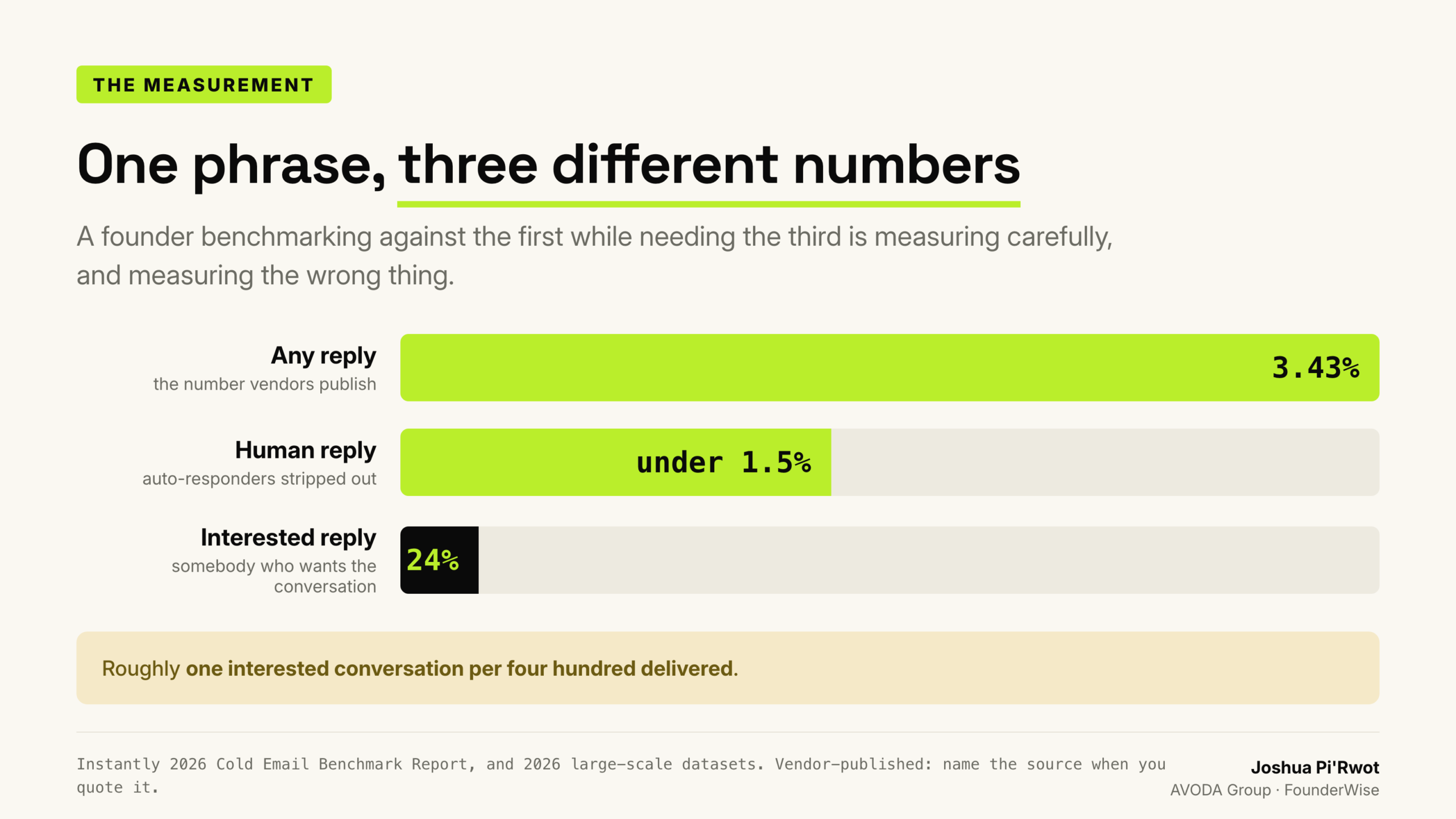
There are at least three distinct things the phrase “reply rate” refers to, and the gap between them is about a factor of fifteen.
Any reply
The headline number. The one vendors publish. Instantly‘s 2026 benchmark report puts the average across its users at 3.43 percent. It counts every inbound message: auto-responders, unsubscribe demands, angry replies, and the genuinely interested.
Human reply
Strip the automated responses and large-scale studies report figures below 1.5 percent.
Interested reply
Somebody who actually wants the conversation. The number that pays rent. One 2026 dataset puts this at 0.24 percent of emails sent.
Three in a hundred, one and a half in a hundred, one in four hundred. All three are honestly reported and all three get called the reply rate. A founder benchmarking against the first number while needing the third is measuring carefully, and measuring the wrong thing.
Before you tune a campaign, find out which of the three numbers you have been looking at.
The Decline Is Real And It Is Long
Instantly’s series, drawn from its own users, runs like this. About 8.5 percent in 2019. Seven percent in 2023. Roughly five percent in 2025. And 3.43 percent in 2026.
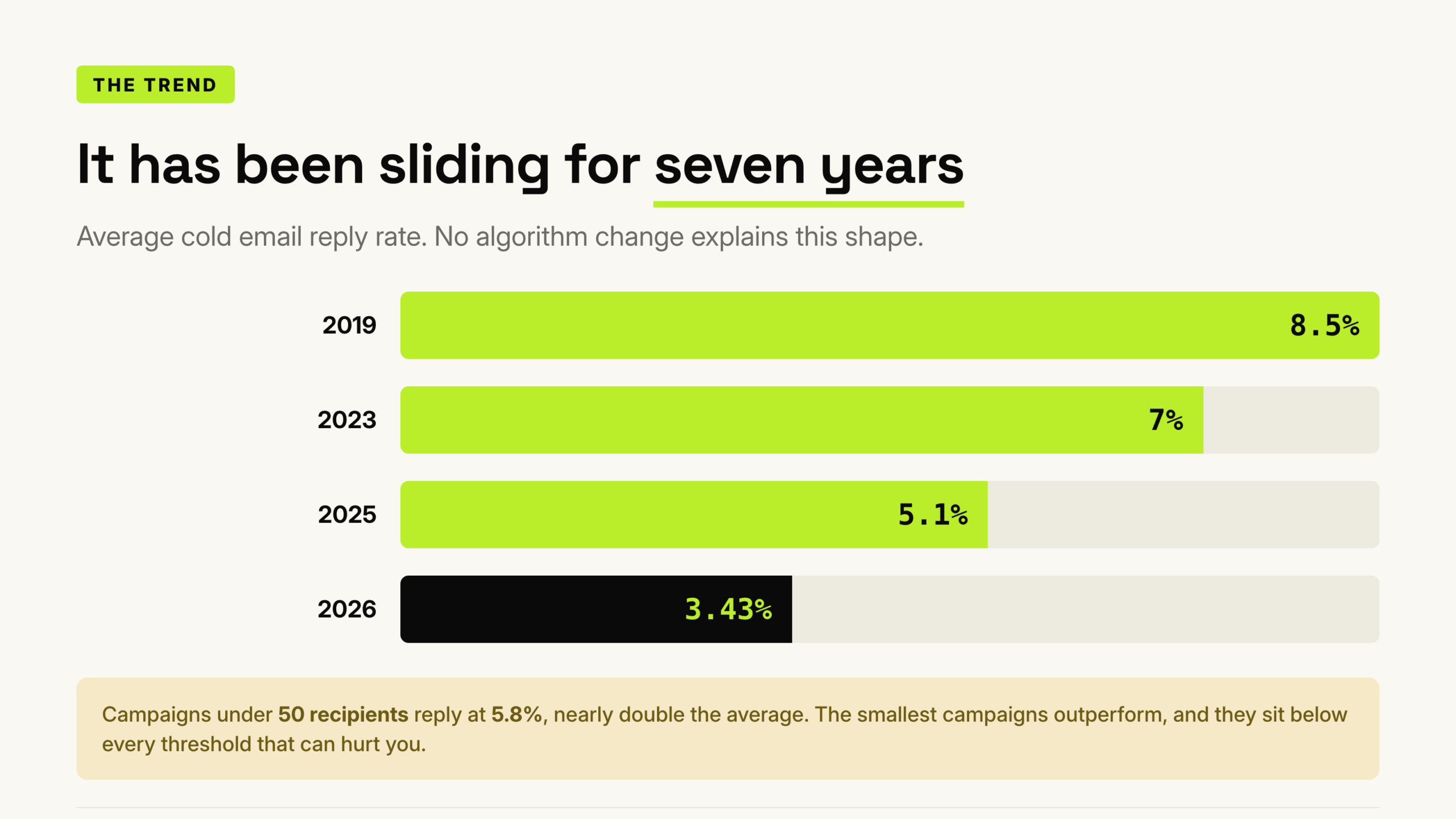
Note the shape. It has been sliding for seven years, with the slide accelerating recently. Algorithm changes explain none of that shape. Reply rates more than halved over the period.
I want to be careful about what that series is. Instantly sells cold-email software and measures its own customers. Every serious benchmark in this category has the same problem: Apollo, Woodpecker, Amplemarket, Lemlist all publish numbers drawn from people who bought their product, usually framed so the product is the answer. Treat the direction as reliable and the decimal places as marketing.
The One Hard Limit, Published And Checkable
Here is the part of this subject with genuinely neutral sourcing, because the publishers have no product to sell you.
Google‘s sender guidelines require bulk senders to keep their reported spam rate below 0.10 percent and to “avoid ever reaching 0.30 percent or higher”. Those are two separate numbers doing two separate jobs: 0.10 percent is the target you are expected to sit under, 0.30 percent is the ceiling where enforcement happens.
Translate 0.10 percent into something you can hold. One in a thousand. It is one complaint per thousand delivered messages. If you are sending five thousand a day, five people pressing the spam button puts you at the line.
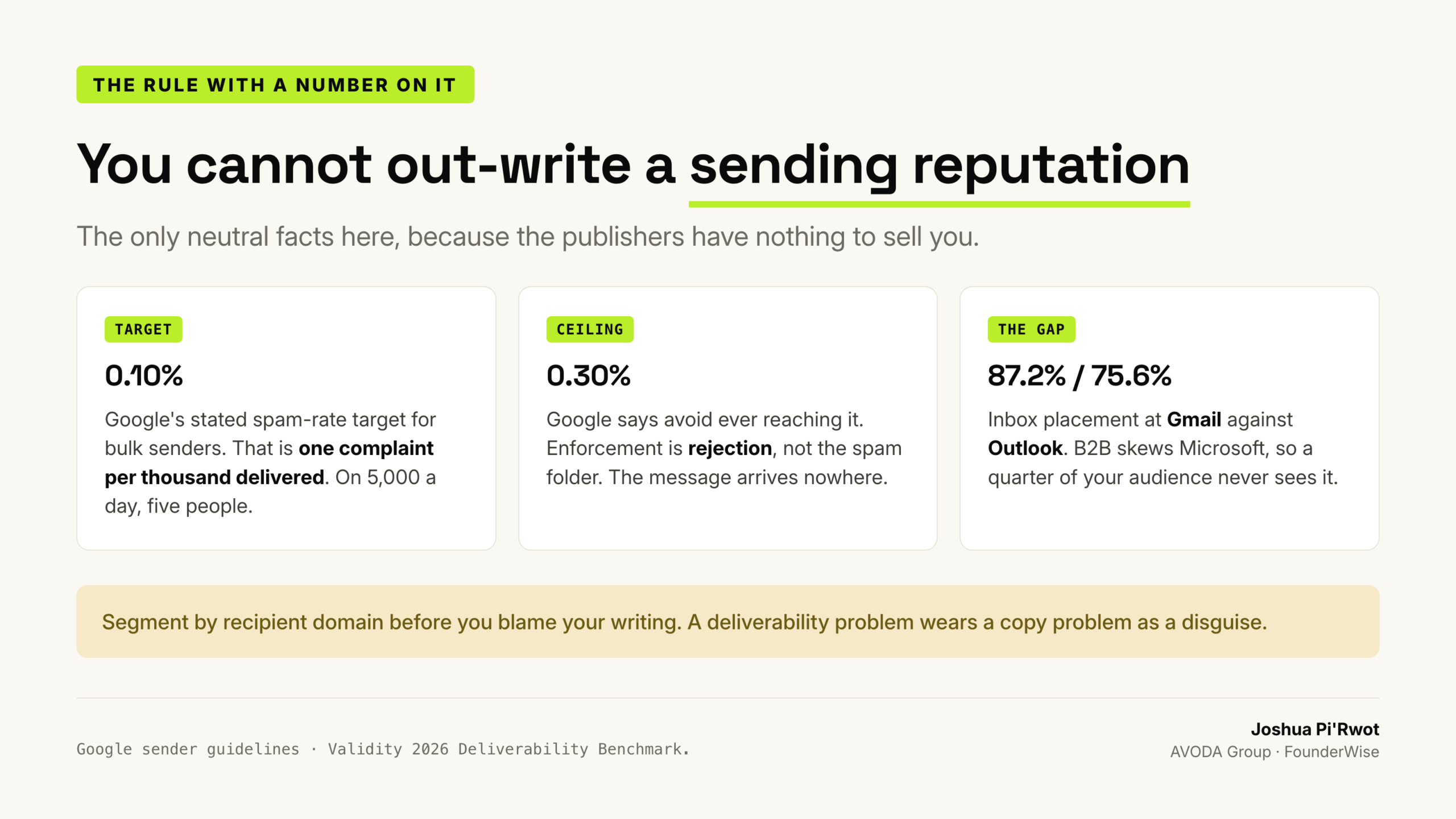
The rules bind at five thousand messages per day to a given provider and require SPF, DKIM and DMARC authentication plus one-click unsubscribe under RFC 8058. Google, Yahoo and Microsoft now all enforce, and the failure mode is rejection rather than the spam folder. The message does not arrive anywhere.
Why this matters more than the copy
Most founders who ask me about outbound want to talk about subject lines. Very few know a hard threshold exists, who sets it, or what their own number is.
Good writing loses to a bad sending reputation every time. Above the line, the quality of the email stops mattering, because delivery has already failed. This is the one part of the system with a published rule and a checkable number, and it is the part people skip.
A Quarter Of Your B2B Audience Never Sees It
Validity‘s 2026 deliverability report puts average global inbox placement at 87.2 percent, up almost four points year over year. Broken out by provider: Gmail 87.2 percent, Microsoft Outlook 75.6 percent.
Sit with that gap. One in four messages headed for an Outlook inbox lands somewhere else.
B2B skews Microsoft heavily. Corporate mail, especially in larger and more conservative organizations, runs on Outlook. So the average B2B campaign loses about a quarter of its intended audience before a single word of the email matters. The founder sees a low reply rate and rewrites the subject line.
Segment your results by recipient domain before you conclude anything about your writing.
If Gmail recipients reply at three percent and Outlook recipients reply at one, you have a deliverability problem wearing a copy problem as a disguise.
Why More Sending Made It Worse
The industry answered falling response by sending more. Follow that arithmetic.
As of 2026, reporting puts the average professional’s inbox at around 121 messages a day, with a large share machine-generated, and the average B2B buyer receiving several times the cold volume they saw in 2023. Both of those figures are weakly sourced and widely recycled, so treat them as color rather than evidence. The behavioral data is firmer.
Roughly 44 percent of B2B sales teams have deployed some form of AI sales agent. Sellers now use AI to generate outreach at volume. Buyers use AI to filter it out. Both sides automate, and the equilibrium settles somewhere worse than where it started: the seller spends more to reach fewer, and the buyer learns to dismiss the entire category on reflex.
The important part is that reflex. Once a buyer has decided that cold email is a category to be ignored rather than a message to be judged, your specific email goes unevaluated. You are competing against a rule the reader made about emails, rather than against other emails.
Do The Arithmetic Before You Do The Campaign
Almost nobody prices this channel before running it, and the calculation takes five minutes.
Take the interested-reply rate, the one that matters, at 0.24 percent. That is roughly one interested conversation per four hundred emails delivered. Not sent, delivered, which after an 87 percent placement rate and a few percent of bounces means you need something closer to four hundred and seventy attempts.
Now put your own numbers through it. If one in four interested conversations becomes a customer, that is around nineteen hundred emails per customer. If your average contract is two thousand dollars, you are spending roughly nineteen hundred sends, plus the list cost, plus the tooling, plus the hours, to earn two thousand dollars once.
If your contract is twenty thousand dollars, the same arithmetic obviously pays off, and the entire question changes.
Cold email is a function of your contract value, and most founders run it without ever putting their own number into the equation.
This is why the same tactic honestly produces triumphant case studies and bitter write-offs. Both are true. They are describing different businesses, and the variable that separates them is almost never the copy.
The version of this calculation that actually stings
Run it in hours rather than dollars. If a well-built campaign of fifty takes you four hours including research, and the under-fifty reply rate holds at 5.8 percent, that is roughly three replies for four hours. Compare that honestly against four hours spent on the customers you already have, or on the twenty people who replied to you last quarter and were never followed up.
For a lot of small businesses, cold outreach is the most expensive way to get a conversation that they are also worst at measuring.
The Domain Advice That Became A Liability
There is a widely repeated playbook here. The answer to sending limits is more sending identities. Buy a handful of lookalike domains, warm them up, rotate the sending across them, keep each one under the threshold.
That advice made sense when the thresholds were per-domain and enforcement was crude. It reads differently now that Google, Yahoo and Microsoft are all enforcing authentication and complaint rates, and rejecting rather than foldering.
The problem is that the practice optimizes for the letter of the rule while broadcasting the intent the rule exists to catch. A cluster of freshly registered lookalike domains, all authenticated, all sending similar content at similar volumes to similar lists, is a recognizable pattern rather than a clever workaround. It also means reputation collapses across the whole estate at once.
There is a second cost, and it goes mostly unmentioned. Every message sent from a near-miss version of your real domain teaches recipients that your real domain is the kind of thing that sends that. You spend the reputation of the asset you actually need in order to protect it.
The honest alternative
Send less from the domain you own, authenticated properly, with a complaint rate you monitor. It is slower, and it is the version that compounds instead of depreciating.
The Finding That Points The Other Way
The same vendor data holds the number that should change what people do.
Campaigns targeting fewer than fifty recipients average a 5.8 percent reply rate, against the 3.43 percent overall average. Smaller campaigns reply at nearly double the rate of the average one.
And the first follow-up peaks at 8.4 percent, frequently higher than the opening email, which most founders learn late because most founders send once.
What that combination implies
Fifty well-chosen recipients with a real second touch will beat a thousand recipients with one. That is what the vendors’ own data says, published by companies whose commercial interest runs the other way, which is exactly why I believe it. It requires no moral claim about personalization.
It also resolves the deliverability problem for free. Fifty messages a day sits far below the five thousand threshold, which puts you outside the bulk-sender rules entirely. Most of the infrastructure anxiety in this field is a problem people opt into by choosing volume first.
Timing Is What Replaces Volume
With more sending ruled out, something has to fill the gap, and “be more personalized” fails as an answer because everyone says it and nobody defines it.
The definable version is timing. A cold message is cold because it arrives at a moment chosen by the sender. Outreach that works arrives at a moment chosen by something that happened to the recipient.
Concretely, that means a short list of events you can detect and act on within days. A company posting a role that implies the problem you solve. A funding announcement. A new executive in the function you sell to. A public complaint about the incumbent tool. A regulatory change landing on their industry.
All of this runs without expensive software. It requires deciding in advance which three events mean something for your business, then checking for them weekly.
Why timing outperforms wording
Because it changes the question the reader is asking. A well-written message at a random moment invites “why are you telling me this”. The same message two days after the triggering event invites “how did you know”. The second is a conversation. The first is a filtering decision.
This also explains the under-fifty finding from a different direction. Small campaigns tend to be small because they were assembled around something specific, and being assembled around something specific is the thing that produces the reply. The size is a symptom of the discipline, not the cause of the result.
Three Reasons To Distrust The Numbers Above
“Every number here comes from a company selling cold email software”
Largely true, and I have tried to say so at each point rather than launder it past you. Two exceptions. The platform rules come from Google and Microsoft directly. The Validity placement data comes from a deliverability company rather than an outbound one. Those are the numbers I would defend. The reply-rate series I would describe, with the publisher named, as the best available rather than as fact.
“This is all US and European data”
It is, and the gap matters for anyone selling in East Africa. Everything here is silent on WhatsApp, where a very large share of business conversation in this region actually happens. It is also silent on the phone call, which still works here in a way it has stopped working in San Francisco. If your buyers are local, the honest reading of this article is that it describes a channel you may be over-indexed on because the internet told you to be.
“So cold email is dead”
I would resist that conclusion specifically. A 0.24 percent interested-reply rate on ten thousand emails is twenty-four conversations, which for some businesses is a quarter of pipeline. The channel works. What died is the version where volume substitutes for judgment, and it died because attention stayed scarce while sending got cheap.
What To Do On Monday
1. Recount your own reply rate, three ways
Total replies, human replies, interested replies. Most people have run these together for years, and separating them takes twenty minutes in a spreadsheet. Whatever you conclude afterward will be about a different business than the one you thought you had.
Then put the answer next to everything else the business is doing. Outbound is one line in a system, and a line only looks good or bad relative to the others. Four hours a week on cold email is excellent if nothing else generates conversations and indefensible if your existing customers are churning unattended.
2. Find your spam complaint rate before you send anything else
Google Postmaster Tools will tell you. Operating without that number means running the one part of the system with a published hard limit while ignoring the gauge.
3. Split your reporting by recipient provider
Gmail versus Outlook, at minimum. If the gap is large, stop editing copy and fix authentication.
4. Cut the list by ninety percent and add a second touch
Under fifty recipients per campaign, chosen deliberately, with one follow-up. The data says that outperforms. It also puts you under every threshold that can hurt you.
You Optimized Hard Against The Wrong Number
Outbound stopped working at scale because the measurement everyone optimized against was the wrong one, and optimizing hard against the wrong number beats doing nothing only in the sense that it is faster. Buyers getting harder had little to do with it. You get more of something nobody wanted, at speed, and the dashboard improves while it happens.
Any number that is easy to move and hard to care about will cost you more than the problem it was meant to measure.
You are ready to run outbound if:
you can state your spam complaint rate, your inbox placement by provider, and your interested-reply rate, from your own data, today.
You are not ready if:
your plan for a low reply rate is to send more. That is the move that produced the decline in the first place, and it is the one the thresholds are built to stop.
Outbound is one line in a system, and a line is hard to judge without seeing the system. FounderWise puts the whole picture in one place: where you stand, what moved since last time, and the calls to make this week, so you can see whether outbound is earning the hours you give it. Free to start, no card: app.founderwise.io
If you would rather talk your numbers through with me first, book a strategy call.
Advice is free. A burned sending domain takes months to rebuild.
Josh
Sources
- Instantly, 2026 Cold Email Benchmark Report
- Google, Email sender guidelines
- Yahoo, Sender best practices
- Microsoft, Outlook requirements for high-volume senders
- RFC 8058, one-click unsubscribe
- Validity, 2026 Email Deliverability Benchmark Report
- Martal, B2B cold email statistics
- Novoslo, why most cold email campaigns are dying in 2026
- Linkedotter, AI SDR adoption in B2B sales, June 2026