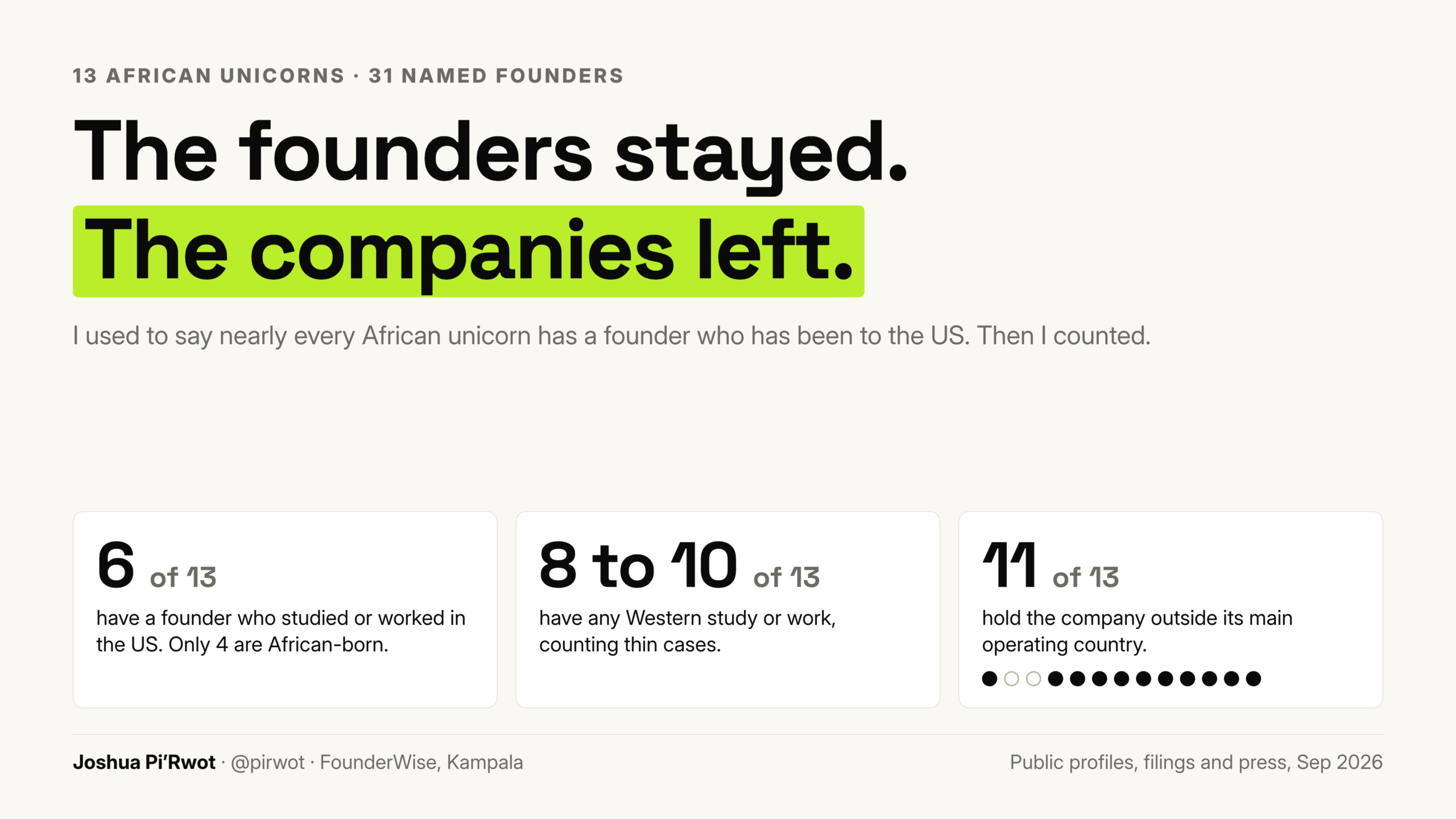
For years I said something in workshops and on calls that I had never checked. I said that nearly every African unicorn has a founder who has been to the US.
It sounded right. It matched the pitch decks I saw with Harvard or MIT on the team slide, and it gave a tidy explanation for a hard fact I have watched for nine years of running founder programs in Uganda: good founders here struggle to raise money that seems to find other people easily.
This week I sat down and counted. I was wrong, and the way I was wrong turned out to be more useful than the belief itself.
The belief I started with
The claim has a strong version and a weak version. The strong version says the US degree or the US job is the ticket. If you want to build a billion-dollar company in Africa, go to America first, pick up the school name and the network, then come home and raise.
The weak version says founders with foreign exposure have an easier time with investors. The wider data backs a lot of that. But the strong version is what I used to say out loud, so I tested it first.
I am writing this from Kampala. FounderWise, LLC is a Delaware company, and it has no physical presence in the US. So I have a personal stake in which version is true.
The thirteen companies
I used a working list of 13 African tech companies that have been valued at a billion dollars or more at some point, whether through a private round or a public market cap: Jumia, Interswitch, Fawry, Flutterwave, OPay, Wave, Andela, Chipper Cash, Swvl, MNT-Halan, Moniepoint, Tyme and Moove.
I left out corporate spin-outs, long-listed incumbents and Seychelles-registered crypto exchanges. The set follows how Multiples.vc and TechCrunch count, with three fallen names kept in because they did cross the line.
That last point needs saying up front. Jumia was Africa’s first tech unicorn in 2016, and on 25 September 2026 its market cap was about $857 million, per StockAnalysis. Swvl reached a SPAC valuation around $1.5 billion and then fell to a market cap of a few million dollars. Chipper Cash raised at $2 billion, and FTX later marked its stake down to a $1.25 billion valuation; one secondary list now places it far lower, which I could not confirm on a primary source. So when I say “unicorn” here, I mean a company that reached the mark at some point.
Between them the 13 companies have 31 named founders. I went through each one: where they studied, where they worked before founding, and where the company is legally held today.
The count
Here is what came back.
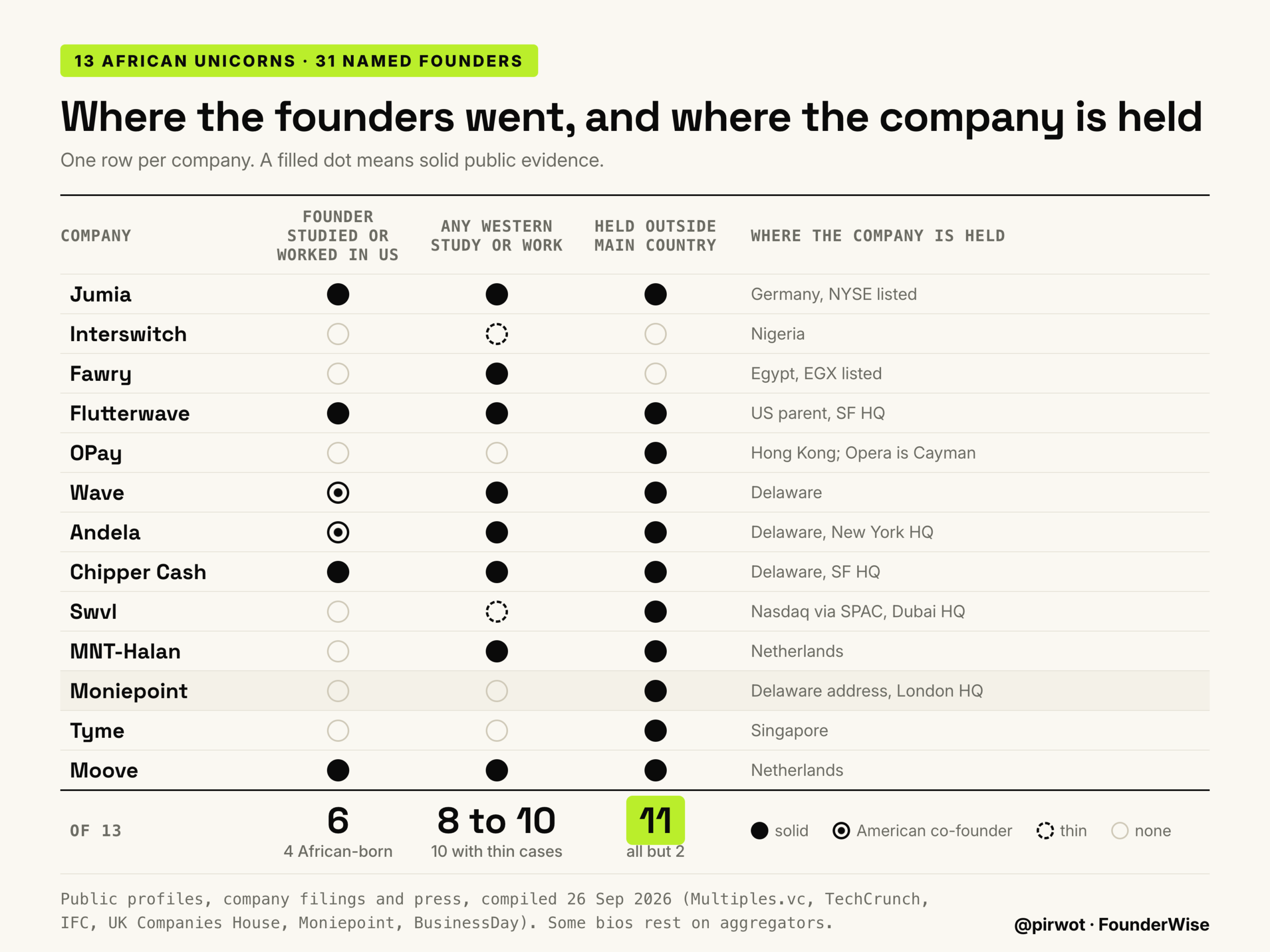
Six of the 13 have at least one founder who studied or worked in the US. That is 46 percent, which is well short of “nearly every.”
It gets smaller when you look closer. Two of those six, Wave and Andela, count because some of their founders are American. Drew Durbin and Lincoln Quirk of Wave met at Brown. Jeremy Johnson and Christina Sass of Andela studied at Princeton and Tufts. Those are real US ties, but they describe Americans building in Africa, which is a different story from the one I had been telling.
That leaves four of 13 where an African-born founder studied or worked in the US: Jumia, Flutterwave, Chipper Cash and Moove. Tunde Kehinde studied at Howard and Harvard Business School and worked at Wachovia Securities. Raphael Afaedor also went through Harvard Business School. Olugbenga Agboola of Flutterwave studied at MIT Sloan and worked at PayPal and on Google Wallet. Ham Serunjogi, who is Ugandan, and Maijid Moujaled, who is Ghanaian, met at Grinnell College in Iowa; Ham interned at Facebook and Maijid worked at Yahoo and Flickr in San Francisco. Jide Odunsi of Moove holds an MIT Sloan MBA alongside degrees from LSE and Oxford.
Four of 13 is 31 percent. My old line was off by a wide margin.
If you widen the test to any Western study or work, meaning the US, the UK, Europe or Canada, the number climbs. On solid evidence it is 8 of 13, adding Fawry, where Ashraf Sabry did an MBA at Leeds, and MNT-Halan, where Mounir Nakhla studied at LSE and the European Business School London. If you count thin exposure, such as a Google internship in Dublin at Swvl or a Wharton module inside an executive program at Interswitch, it reaches 10 of 13.
Three companies have zero Western study or work among their founders: Moniepoint, Tyme and OPay.
And then there is the number that surprised me most. Eleven of the 13 hold the company outside the country where it mainly operates. Only Interswitch and Fawry are held at home.
Founder backgrounds and holding structures
This table summarizes each company’s founders’ Western study and work, from public profiles, and where the company is legally held. Some bios rest on aggregators and press profiles, so treat single lines with care.
| Company | Founders’ Western study or work | Where the company is held |
|---|---|---|
| Jumia | Kehinde: Howard, Harvard MBA, Wachovia. Afaedor: Harvard MBA, Goldman Sachs London. Poignonnec: McKinsey Paris and New York. Hodara: HEC Paris, McKinsey | Germany (Jumia Technologies AG), NYSE listed |
| Interswitch | Elegbe: University of Benin, worked in Nigeria; one executive program with a Wharton module | Nigeria |
| Fawry | Sabry: MBA, University of Leeds, UK. Okasha: ESLSCA MBA, campus unconfirmed | Egypt, EGX listed |
| Flutterwave | Agboola: MIT Sloan, PayPal, Google Wallet. Aboyeji: Waterloo, Canada. Adekoya: Maryville University, possibly online | US parent, San Francisco HQ (state unconfirmed) |
| OPay | Zhou Yahui: Tsinghua, China; career in China | Hong Kong operating parent; Opera is Cayman |
| Wave | Durbin and Quirk: American, Brown University | Delaware (Wave Mobile Money Holding Inc.) |
| Andela | Johnson (Princeton), Sass (Tufts), both American. Aboyeji, Enegesi, Nkengsa: Waterloo. Carnevale: Toronto | Delaware, New York HQ |
| Chipper Cash | Serunjogi: Grinnell, Facebook US and Dublin. Moujaled: Grinnell, Yahoo and Flickr in San Francisco | Delaware entity, San Francisco HQ |
| Swvl | Kandil: American University in Cairo, Google internship in Dublin. Nouh and Sabbah: backgrounds unverified | Nasdaq via SPAC, Dubai HQ (jurisdiction unverified) |
| MNT-Halan | Nakhla: LSE, European Business School London. Mohsen: AUC, IBM Egypt | Netherlands |
| Moniepoint | Eniolorunda: Obafemi Awolowo, Lagos Business School, Interswitch. Ike: University of Lagos, Interswitch | Moniepoint Inc., Wilmington, Delaware address; London HQ since 2023 |
| Tyme | Jonker: Free State, GIBS, Standard Bank, Deloitte SA. Van der Walt: Deloitte SA | Singapore (Tyme Group Pte Ltd) |
| Moove | Odunsi: LSE, MIT Sloan, Oxford, Goldman Sachs, McKinsey. Delano: SOAS, Oxford, LSE | Netherlands (Moove Africa B.V.) |
Moniepoint
Moniepoint is the case that changed how I think about this.
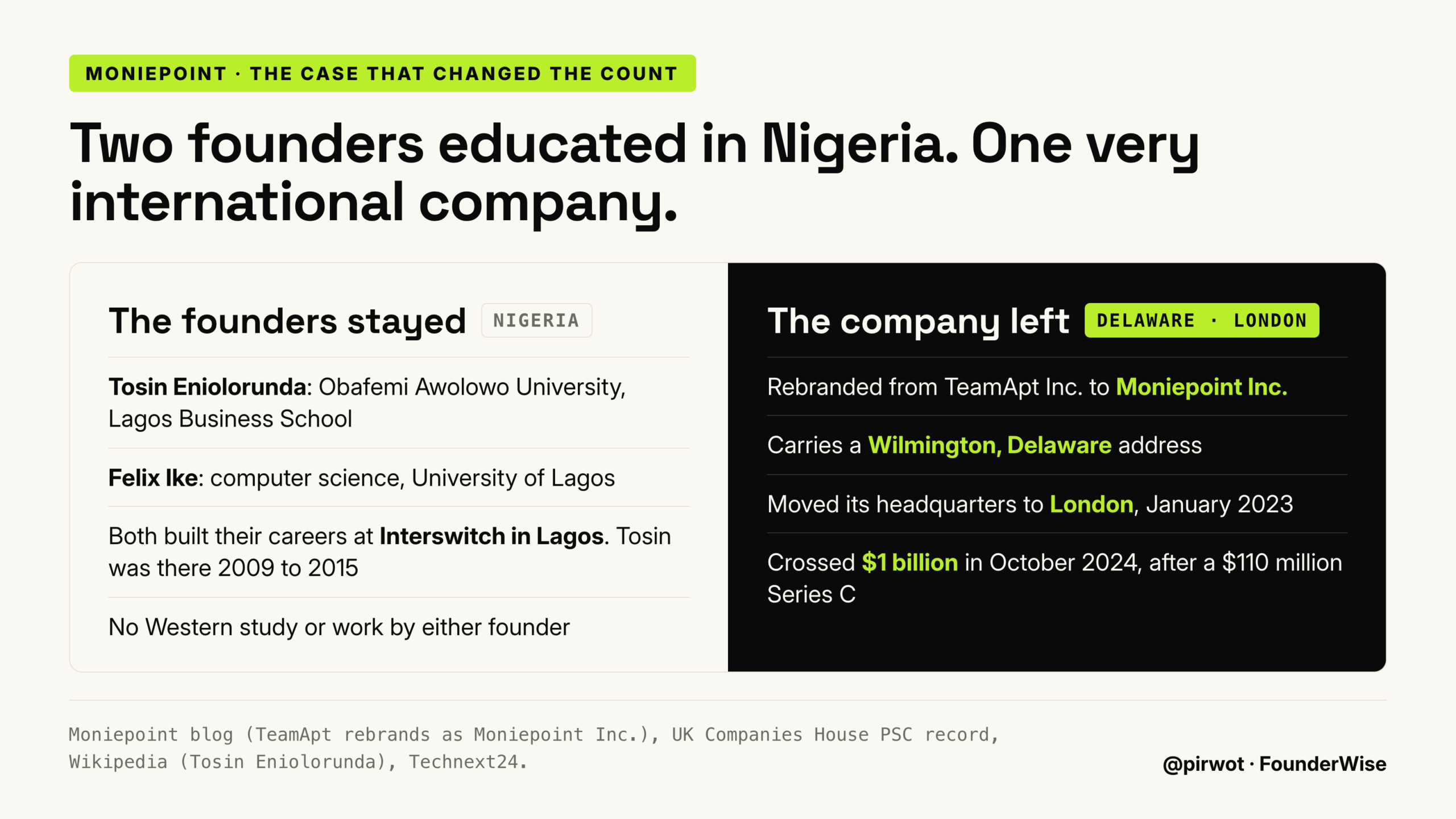
Tosin Eniolorunda studied at Obafemi Awolowo University and Lagos Business School. Felix Ike studied computer science at the University of Lagos. Both built their careers at Interswitch in Lagos. Tosin was there from 2009 to 2015. Both paths ran entirely through Nigeria. By my old claim, these were the founders with the harder road.
They built a company that crossed a billion dollars in October 2024 after a $110 million Series C.
And the company looks very international on paper. It rebranded from TeamApt Inc. to Moniepoint Inc., it carries a Wilmington, Delaware address, and it moved its headquarters to London in January 2023, according to its own blog and UK Companies House records.
The founders stayed. The company left.
That is the pattern I had been half-seeing and misnaming. What traveled was the company’s legal home, its investors, and the address a fund lawyer sees on the cap table.
What the wider funding data shows
Thirteen winners is a small sample, and it only counts the companies that made it. The better evidence for who gets funded comes from studies of all funded founders. Those point in the same direction as my old belief, even though my specific claim about unicorns was wrong.
Africa: The Big Deal looked at CEOs of African startups that raised $1 million or more since 2019. In its May 2021 analysis, 35 percent studied at an African university, 31 percent in Europe and 29 percent in the US. The top foreign schools were Harvard, Oxford, MIT and Columbia. The country split was sharp: in Kenya only 16 percent of those CEOs were locally educated, in Nigeria 28 percent, and in South Africa and Egypt about two in three.
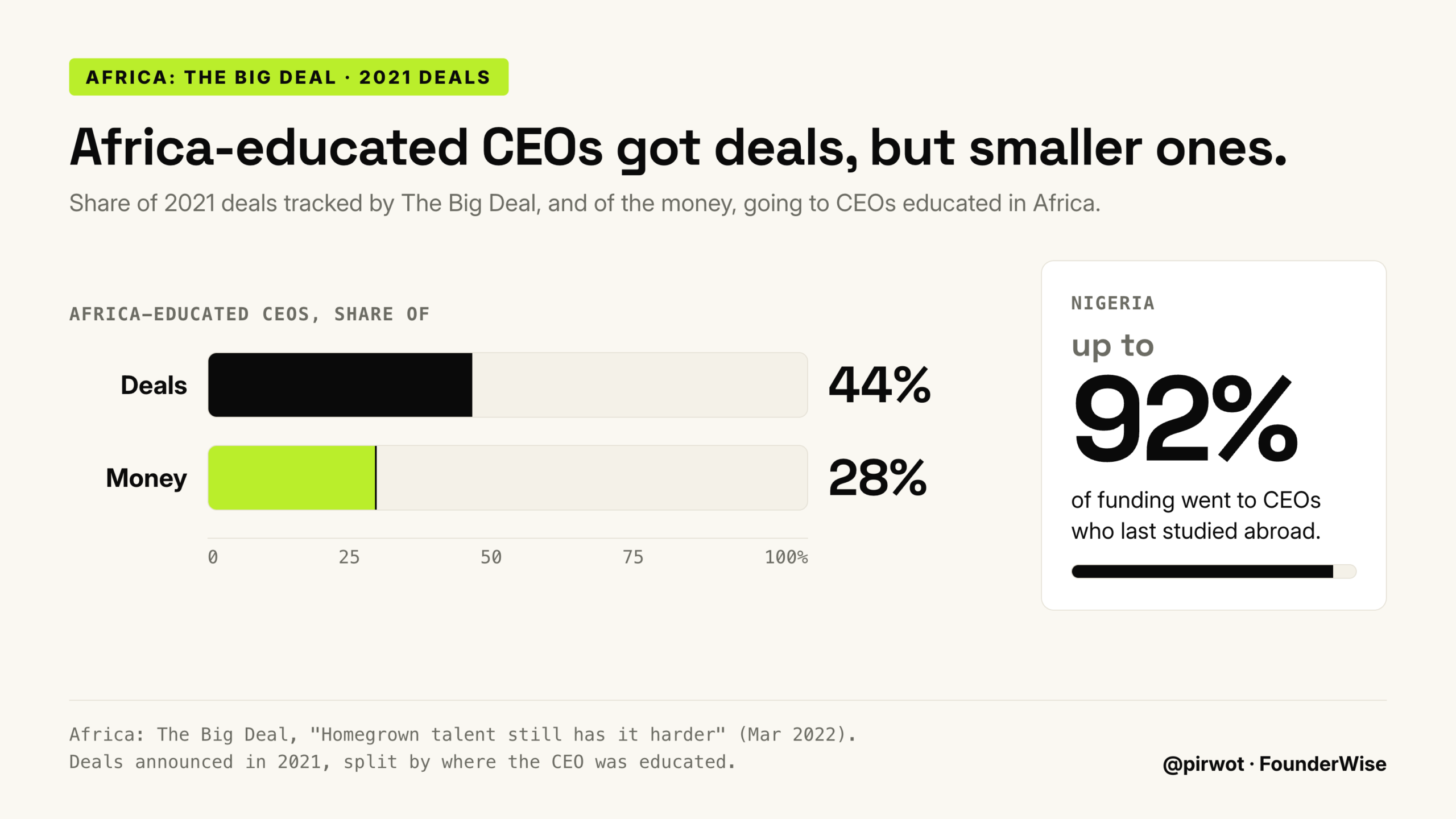
A year later, The Big Deal looked at 2021 deals. CEOs educated in Africa signed 44 percent of the deals but raised 28 percent of the money. In Nigeria, CEOs who last studied abroad raised up to 92 percent of funding. So Africa-educated founders were getting deals, but smaller ones.
The Global Private Capital Association looked at rounds of $500,000 and above from 2019 to 2022. In 2022, founders educated only abroad or with a mix of foreign and local education raised more than $1.6 billion, 73 percent of the capital. In Kenya, teams made up only of non-Africans took 52 percent of capital that year. In Nigeria, 67 percent went to startups with at least one founder educated abroad.
East Africa shows the gap most clearly. Village Capital‘s 2017 report, “Breaking the Pattern,” found that 90 percent of disclosed East African startup investment in 2015 and 2016 went to companies with at least one European or North American founder, as reported by Rest of World. Viktoria Ventures counted Kenyan startups that raised $1 million or more in 2019: one had a local founding team, four had mixed teams and eleven were expat-only. For comparison, the same work found 55 percent Nigerian founders among Lagos raises and 56 percent local founders in South Africa.
The newest evidence is a 2026 NBER working paper, “Startups in Africa,” by Colonnelli, Cruz, Pereira-Lopez, Porzio and Zhao, using World Bank and VC4A data. It finds that about 80 percent of African venture deals involve a foreign investor, and that about two-thirds of funded founders studied or worked outside Africa.
Put those together and a fair reading is this. A foreign degree helps a lot on average, especially in Kenya and Nigeria. My unicorn claim just overstated it, and it pointed at the founder when a bigger share of the story sits with the company.
Why the pattern holds
I want to be careful here, because the easy move is to call all of this bias and stop thinking. The research points to at least four mechanisms, and they deserve to be taken one at a time.
The first is where the money sits. If about 80 percent of deals involve a foreign investor, the person deciding usually lives in San Francisco, London or Dubai. A founder who has lived in that city, or studied with people who now work at those funds, has a shorter path to the first meeting. The Big Deal’s country split fits this. Egypt and South Africa have deeper local capital pools, and a Quartz summary of the same data put the share of funding going to locally educated CEOs there at 77 and 81 percent. Where the investor is local, local training reads just fine.
The second is networks formed at school and work. The Chipper Cash founders met at Grinnell. Wave’s founders met at Brown. Andela’s African co-founders came out of Waterloo. Jumia’s African co-founders met at Harvard Business School. Moove’s founders met as students in London. These are founding teams built abroad, and the relationships came with them. That matters more than any single line on a CV.
The third is pattern matching. Harvard, Oxford, MIT and Columbia top the list of schools among funded African CEOs, and an investor reviewing hundreds of decks learns to read those names as a shortcut. It saves time. It also means a founder whose best evidence is years of hard work inside a Lagos payments company has more explaining to do.
The fourth is legal structure, and this is the one that explains Moniepoint. Y Combinator says plainly on its deal page that it invests in US, Canadian, Cayman and Singapore corporations. AVCA data, cited by Launch Base Africa in January 2026, found that 21 percent of African VC deals from 2014 to 2019 went to startups headquartered outside the continent, and more than half of those were US-incorporated. Briter reported in August 2026 that half of African funding in the first half of 2026 went to entities incorporated outside Africa. One founder quoted by Launch Base Africa put it simply: companies move to Delaware because arguing with US investors about Nigerian company law costs more than the move.
There is a fifth possibility I will name as a hypothesis only: access to US payment rails and US strategic capital. Wave’s owners above 5 percent include Stripe and Founders Fund, according to an IFC disclosure. Chipper Cash is headquartered in San Francisco. It is plausible that being close to American payment infrastructure helps a fintech scale. I found no study that isolates it as a cause, so I am leaving it as a question.
What investors are up against
It would be unfair to write this as though investors are simply choosing people who look like them. Some of that happens, and the Kenya numbers made it a public argument in 2021. But a lot of what shapes these outcomes is structural, and investors carry real constraints too.
A fund has its own investors, lawyers and fund documents, and many are set up to hold shares only in certain jurisdictions. Enforcing a shareholder agreement or handling an exit can be slower and riskier across some legal systems. When YC says it invests in US, Canadian, Cayman and Singapore corporations, that is a rule about what it can hold, and a founder in Kampala should read it as a practical fact.
There is also the question of what an investor can check from a distance. A US credit file, a known school, a known former employer: a partner can verify these in an afternoon. A strong record built in an unfamiliar market takes longer to confirm, and time is what every fund is short of.
So my complaint is narrower than “investors are unfair.” The signals that are cheap for them to read happen to be the ones that are expensive for most African founders to acquire.
Where the pattern breaks
The exceptions matter as much as the rule.
Egypt and South Africa produced unicorns with founders trained at home or in the UK. Fawry, MNT-Halan and Swvl came out of Egypt. Tyme came out of South Africa, founded by people from Standard Bank and Deloitte, spun out of Deloitte, bought by Commonwealth Bank of Australia and then bought back, according to Leadership Online. Interswitch in Nigeria was built by a founder who studied at the University of Benin and worked at Schlumberger and TELNET.
The pattern is by country more than by continent. Nigeria-origin unicorns lean on founders with foreign training, with Moniepoint and Interswitch as the exceptions. Egypt and South Africa lean the other way. That lines up with The Big Deal’s education data.
The newer unicorns also draw on more varied capital. Tyme’s $250 million Series D in December 2024 was led by Nubank from Brazil. Moove’s $250 million Series C in August 2026 was led by Mubadala, with Toyota’s Woven among its backers. OPay grew with Chinese capital through Opera. MNT-Halan raised from Apis and DisrupTech. None of these depended on an African founder with a US route.
The gate I was describing is less fixed than I thought, and it widens as more kinds of investors show up.
The limits of this count
A few honest caveats before the conclusion.
Thirteen companies is a small sample. Recoding one or two founders moves the percentages by about eight points each.
Some founder bios rely on aggregators like Clay, The Org and Crunchbase, and on press profiles. Olugbenga Agboola’s degree differs across sources: one says an MIT Sloan MBA, another says an Oxford MBA plus an MIT Sloan program. Either way he studied at MIT Sloan. Adeleke Adekoya’s Maryville degree may have been online, so coding it as US study is generous. I could not verify the backgrounds of two Swvl co-founders or where Fawry’s Mohamed Okasha did his MBA.
Valuations are marks, and marks move. Interswitch’s billion is from 2019. Fawry’s is a public market cap in a currency that has lost value.
And this is survivorship data. It counts the winners and hides everyone who tried the same route and fell short. The studies of all funded founders are the stronger evidence, and they are less comfortable reading than my unicorn count.
What this means for a founder building from here
Here is where I have landed.
A company has to be readable to capital from a distance. The investor is usually far away, busy, and working under legal rules about what they can own. They need a way to trust what they cannot see.
Right now there are three common ways African companies become readable. The first is a foreign degree or foreign job, which carries a school or employer name the investor already trusts. The second is a foreign holding company, a Delaware, London, Amsterdam or Singapore parent that fund lawyers know how to handle. The third is a known investor, an earlier backer whose name tells the next one that someone did the checking.
Moniepoint’s founders used the second and third. Chipper Cash’s founders had all three. Tyme found its readability through a strategic investor from Brazil.
There should be a fourth way, and it should start with the founder’s actual work: the customers they spoke to, what they learned, the product they tested, and the money that actually came in. That record exists for thousands of founders across Kampala, Lagos, Nairobi and Kigali. It sits in notebooks, WhatsApp threads and spreadsheets where an investor in London has little chance of finding or trusting it.
I have spent nine years watching founders do the hard part and then struggle to show it. Tosin and Felix proved the hard part can be done from Lagos with a Lagos education. The part that still needed a US “Inc.” was the part investors read.
Where FounderWise comes in
That is what I am building FounderWise toward, and I want to be straight about where it stands. MVP Studio went live yesterday, on 25 September 2026. Seven founders signed up in the first three hours. Revenue so far is zero. It is early, and I am learning from every founder who uses it.
MVP Studio helps you turn the work you are already doing, customer conversations, product tests, early sales, into a record someone far away can read. If that is useful to you, start at app.founderwise.io/mvp. And if you want to talk through how your company reads to capital, or whether a flip makes sense for you, book a strategy call at cal.com/pirwot/strategy-call.
If you have moved your company to Delaware, London or Singapore, what changed first: who would take your call, or who could sign the check?
Sources
- Multiples.vc, Africa unicorns (Sep 2026)
- TechCrunch, Africa’s biggest startups by valuation (Mar 2025)
- StockAnalysis, Jumia market cap
- TechCrunch, FTX marks down Chipper Cash (Dec 2022)
- Billionaires.Africa, Swvl market cap (Mar 2023)
- Moniepoint, TeamApt rebrands as Moniepoint Inc.
- UK Companies House, Moniepoint PSC record
- Wikipedia, Tosin Eniolorunda
- Technext24, Africa’s unicorn founders (Jun 2025)
- Grinnell College, Ham Serunjogi
- BusinessDay, Moove founders
- IFC disclosure, Wave
- Leadership Online, Tyme
- Tyme, Nubank-led round
- Mubadala, Moove Series C
- Africa: The Big Deal, Where did your CEO study (May 2021)
- Africa: The Big Deal, Homegrown talent still has it harder (Mar 2022)
- GPCA, Africa startup funding: who is getting backed (Apr 2023)
- Rest of World, Kenya and local founders (2021)
- NBER w35261, Startups in Africa (2026)
- Y Combinator deal page
- Quartz, VC fundraising and African CEOs who studied abroad
- Launch Base Africa, the Delaware flip (Jan 2026)
- Briter, Africa Venture Pulse 2026