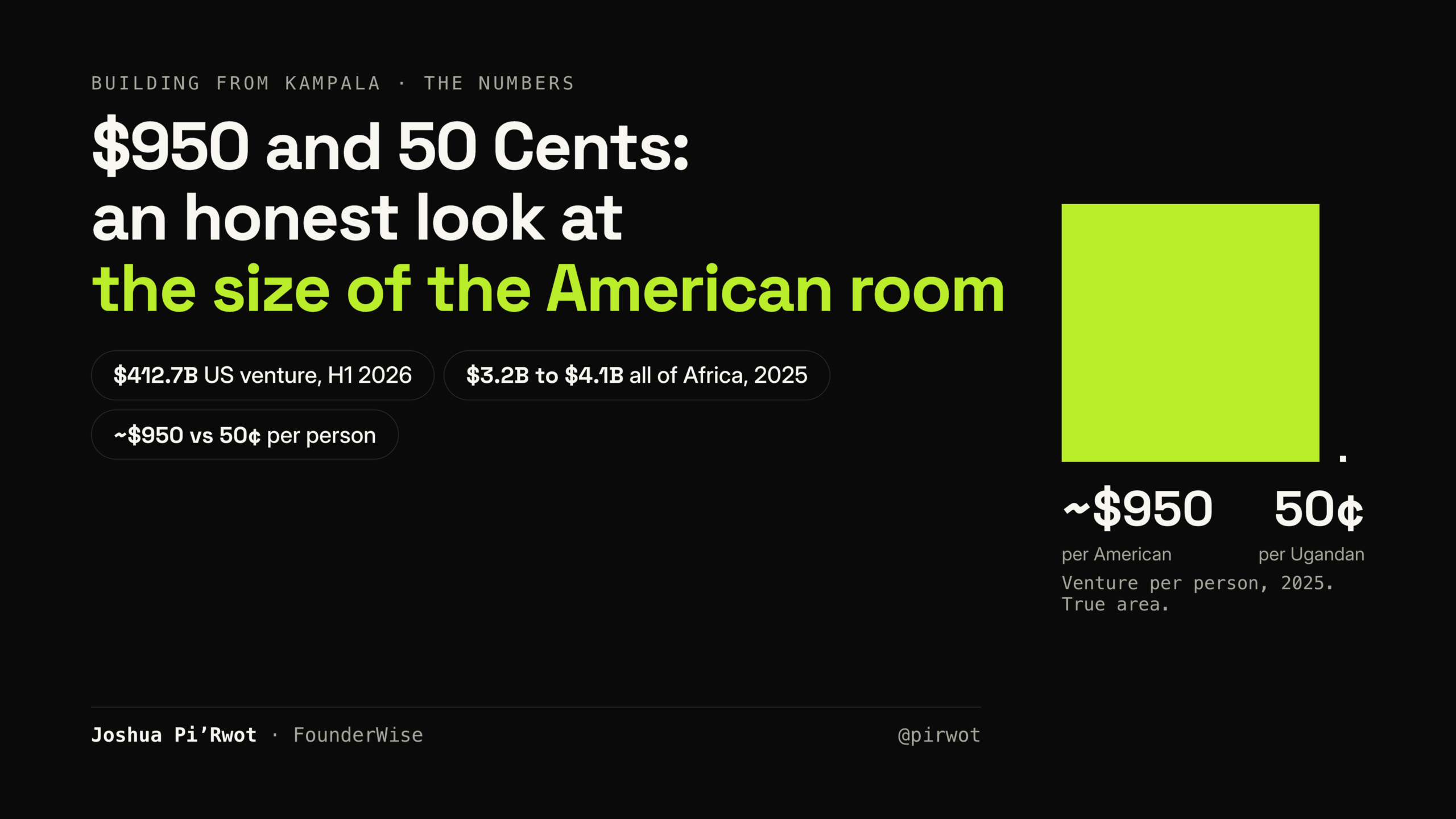
In the first six months of 2026, US startups raised $412.7 billion. That figure comes from the PitchBook-NVCA Venture Monitor for the second quarter, and it is already larger than the whole of 2025.
In all of 2025, startups in Uganda raised somewhere between $22 million and $30 million. Partech counts $22 million. Africa: The Big Deal, as reported by The EastAfrican, counts $30 million. The gap between those two estimates would pass for a healthy seed round in a lot of cities.
I run founder programs in Uganda. For nine years I’ve been Country Director for the AVODA Institute of Entrepreneurship, where we’ve trained more than 600 founders and supported more than 100 startups. This year I also started building a company of my own, FounderWise, from Kampala. It’s a Delaware LLC run entirely from here. Since July I’ve collected 13 accelerator rejections and one acceptance, into the 1752vc GTM Accelerator. A US card provider declined us for having no US presence, and later our bank froze our card. Yesterday, 25 September, our first product, MVP Studio, went live. Seven founders from the first cohort signed up in three hours. Revenue so far is zero.
I’m telling you that so you know where I’m standing when I look at the numbers. I’ve spent the last few weeks trying to measure the American room honestly: how big it is, what’s in it, who gets in, and what a founder here can reasonably do about it. This is what I found.
The headline numbers, and what inflates them
Start with the big figure and then take some of the air out of it, because it deserves that.
PitchBook and the NVCA put US venture deal value at $412.7 billion for the first half of 2026. Megadeals, meaning rounds of $100 million or more, made up 87.5% of that value. AI companies took about 86% of it. Seven rounds of $1 billion or more in the second quarter alone added up to $87.2 billion, and one of those, Anthropic’s $65 billion round, is roughly sixteen times everything African tech raised in 2025 by Partech’s count. Crunchbase, using its own method, found that OpenAI and Anthropic together accounted for 43% of global venture funding in the first half.
So the headline mostly describes a handful of AI labs. A founder in Ohio raising a first round lives in a very different market from those labs, and so does a founder in Kampala.
The fairer comparison uses the rounds under $100 million. In the first half of 2026, those still came to $51.4 billion in the US, per the same PitchBook-NVCA report. That’s about twelve times Africa’s entire 2025 total as Partech measured it. Strip out every megadeal and the ordinary American founder’s market, over six months, is still an order of magnitude larger than a full year of the continent’s.
The other number I keep coming back to is the count of beginnings. PitchBook and the NVCA recorded 5,674 US companies raising their first venture round in those six months. Partech counted 570 deals across all of Africa in 2025, at every stage, equity and debt together.
Africa’s number depends on who’s counting
I’ve learned to name the tracker every time, because the three main ones disagree, sometimes by a factor of two.
For 2025, Partech reports $4.1 billion for Africa, made up of $2.4 billion in equity and $1.6 billion in debt, counting rounds of $200,000 and up. Africa: The Big Deal reports $3.2 billion, counting rounds of $100,000 and up. Briter reports $3.8 billion. For the first half of 2026 the spread widens: The Big Deal has about $1.4 billion, and Briter has $3.3 billion for the same six months.
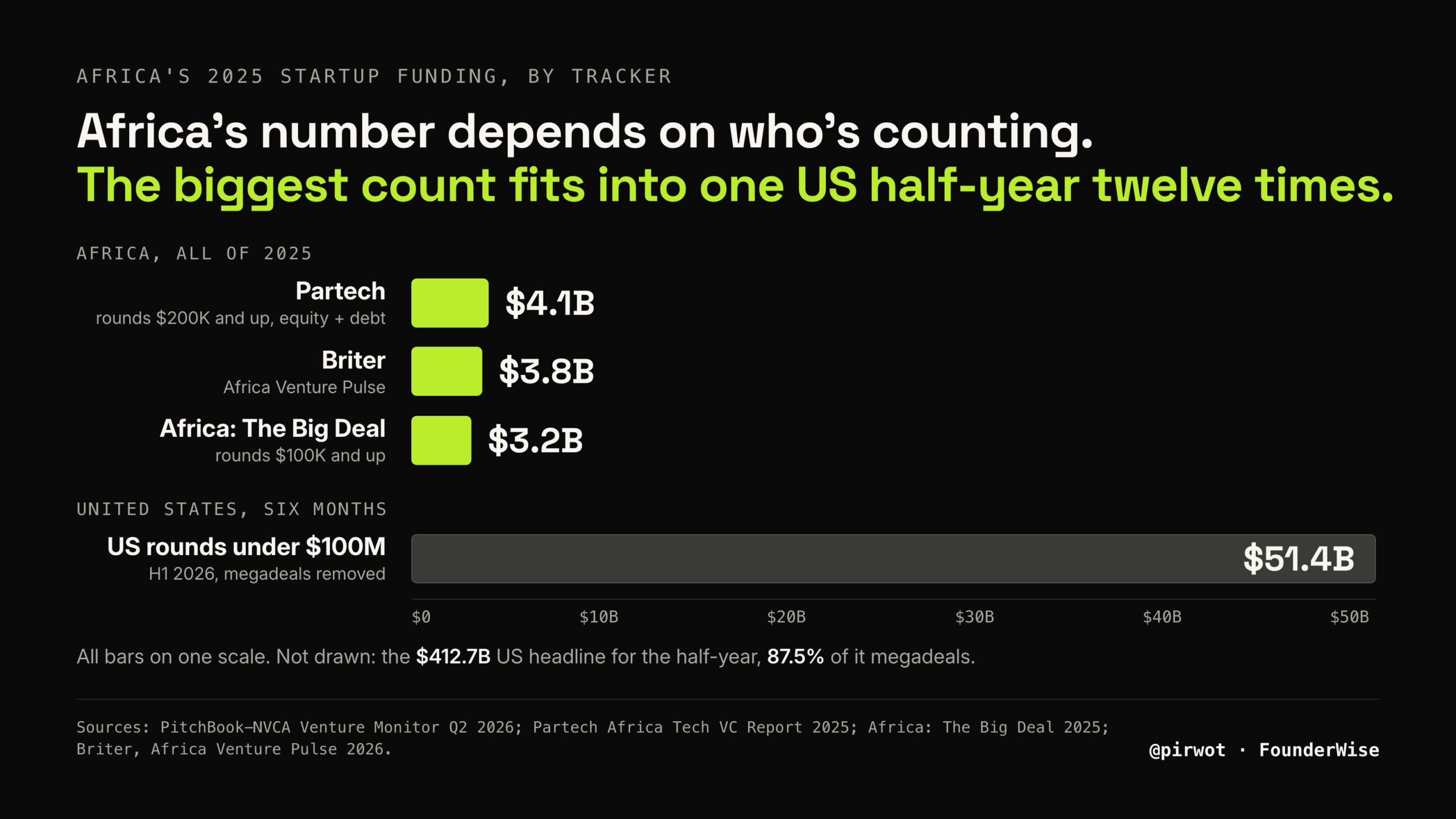
They differ on thresholds, on how they treat debt, and on whether large energy and asset-finance raises count as startup funding. Each one is honest about its method. Anyone quoting a single figure for “African funding” without saying whose has quietly picked a side.
Concentration matters as much as the total. Partech found that Nigeria, Kenya, Egypt and South Africa took 72% of the capital in 2025. Uganda came tenth on Partech’s country list, with $21 million in equity and $1 million in debt. Partech also counted 25 unique active equity investors in Uganda that year, up from 12 the year before.
That’s a real improvement, and I’m glad of it. It’s also a group you could seat around two dinner tables.
Per person
Totals hide population, so I divided.
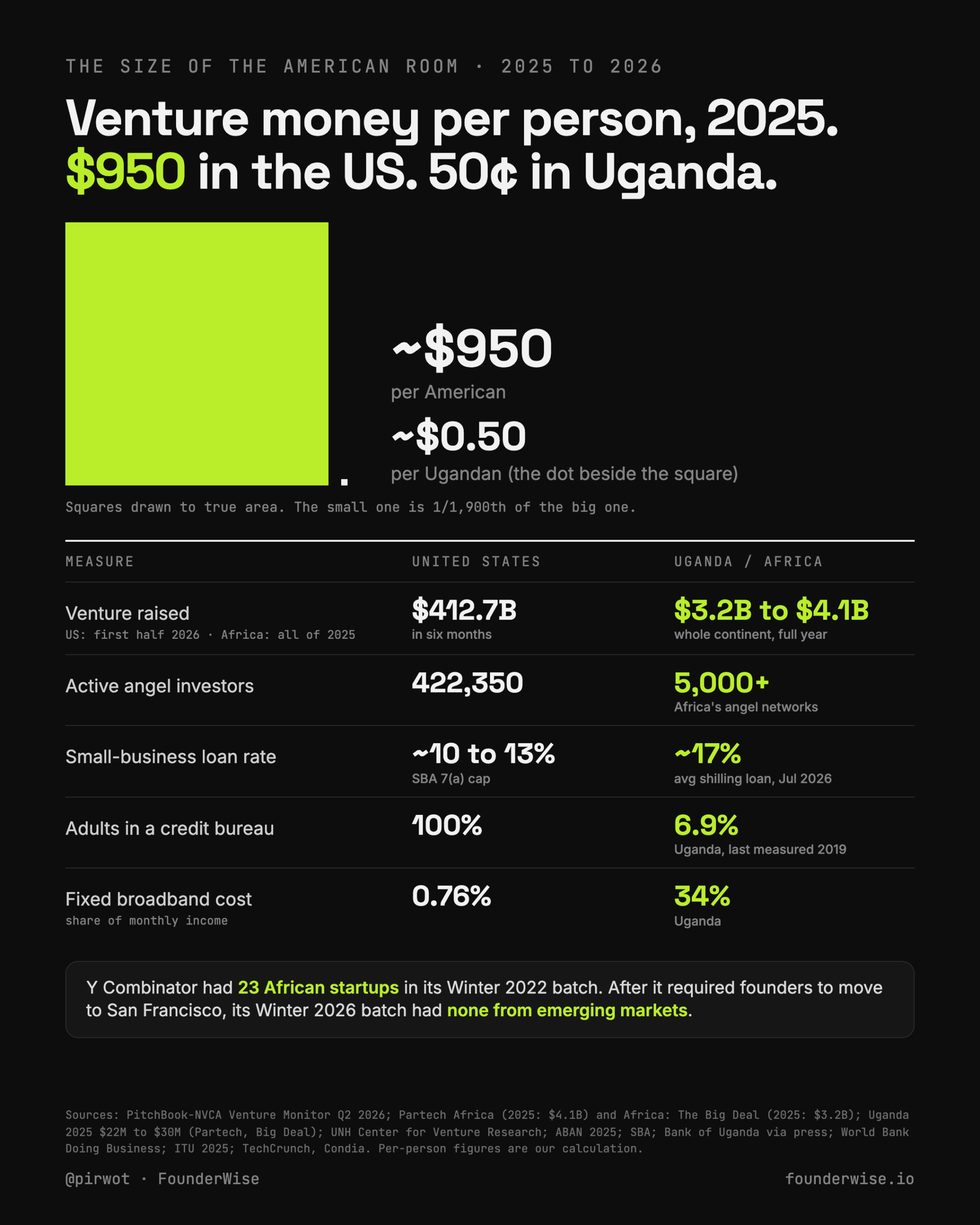
Using the Census Bureau’s estimate of about 341.8 million Americans in 2025, US venture funding that year comes to roughly $934 to $993 per person. The range depends on which PitchBook-NVCA report you use for the year: $319.2 billion as restated in the Q2 2026 Monitor, or $339.4 billion from the Q4 2025 Monitor. Call it about $950.
Africa, at roughly 1.55 billion people, comes to about $2.06 to $2.65 per person across the three trackers. That’s a gap of roughly 350 to 480 times.
Uganda, at around 49 million people, comes to about 45 to 61 cents per Ugandan, depending on whether you use Partech or The Big Deal. Call it 50 cents. Against the American figure, that’s a gap of roughly 1,500 to 2,100 times.
Those are my own calculations from the cited totals, and they carry every weakness of the totals underneath them. The order of magnitude survives whichever tracker you pick.
$950 and 50 cents.
Angels and seed rounds
Venture funds are the visible part. The layer underneath them is where most founders actually start, and in the US it’s even thicker.
The University of New Hampshire’s Center for Venture Research counted 422,350 active angel investors in the US in 2023. Together they put about $18.6 billion into 54,735 startups that year, with an average angel deal of $339,390. The Angel Capital Association’s 2026 report, published in July, says its reporting groups alone invested $491.3 million in 2025.
The African Business Angel Network‘s 2025 survey, run with UNDP and Briter, counts more than 5,000 angels across more than 110 networks on the whole continent. Over 90% of them write checks under $25,000. Respondents to that survey reported about $4.4 million invested. Twenty-nine percent said they had paused or cut back, and 41% said they were investing with caution. The ACA and ABAN figures come from different survey samples, so I read them as a picture of scale and leave the exact ratio alone.
Seed rounds show the same shape. The PitchBook-NVCA report puts the US median seed deal at about $3.0 million for the first half of 2026, down from $3.5 million in 2025. That figure was read off a chart label in the PDF, so treat it as approximate until someone checks the underlying data. Partech reports an average Seed+ ticket in Africa of $1.7 million in 2025. That sounds close until you notice three things: it’s an average, it only counts rounds of $200,000 and up, and it sits on 311 deals for the whole continent. Some outlets have called it a median. Partech’s own report says average.
The number I find most sobering is further down the Partech report. African seed cohorts from 2021 to 2023 converted to Series A at only 5.5% to 6.5%. Getting the first check here is hard.
Getting the second one is harder.
Accelerators and the San Francisco requirement
The accelerator deals in the US are generous, and I want to say that plainly.
Y Combinator’s standard deal is $500,000: $125,000 for 7% on a post-money SAFE, plus $375,000 on an uncapped SAFE with most-favored-nation terms. It now runs four batches a year. The a16z speedrun deal is up to $1 million: $500,000 up front for 10%, and another $500,000 in the company’s next round within 18 months, plus partner credits the official page puts at more than $10 million. Speedrun’s acceptance rate has been reported at under 0.4%, so the door is tight for everyone who knocks.
Tracxn counts 3,093 accelerators and incubators in the US as of January 2026. The best Africa count I found is 618 to 643 tech hubs of every kind, from a 2019 study by GSMA and Briter, and only about 14% of those are accelerators. The two counts measure different things and the African one is old, so I hold it loosely. The difference in scale is still plain.
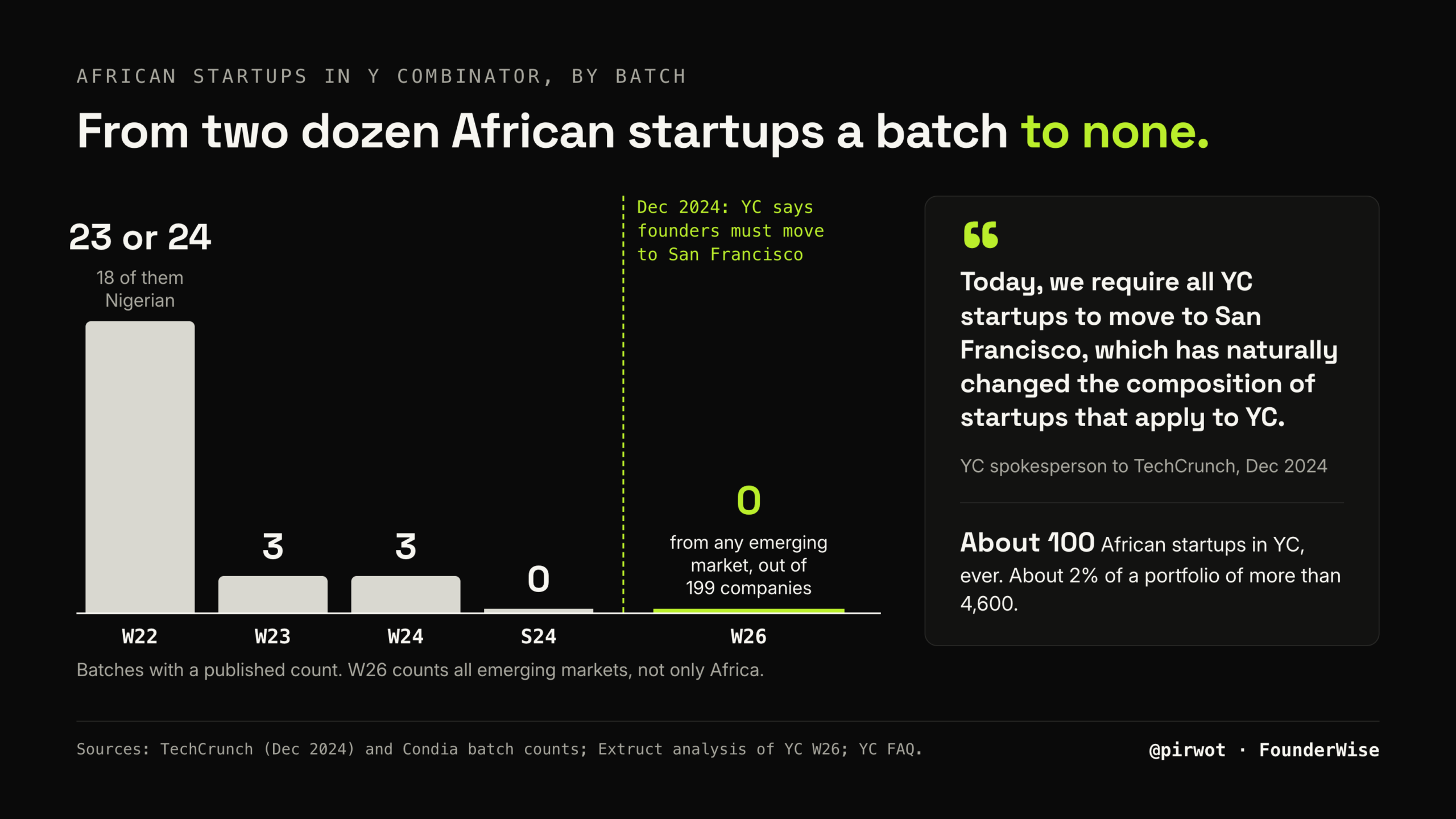
Then there’s location. YC’s FAQ says the batch takes place in person in San Francisco. In December 2024 a YC spokesperson told TechCrunch: “Today, we require all YC startups to move to San Francisco, which has naturally changed the composition of startups that apply to YC.”
You can see that change in the batches. By the counts TechCrunch and Condia reported, the Winter 2022 batch had 23 or 24 African startups, 18 of them Nigerian. Winter 2023 had three. Winter 2024 had three. Summer 2024 had zero. Extruct’s analysis of the Winter 2026 batch, 199 companies, found zero startups from emerging markets, and 67% of the companies with a known location were in California. Across its whole history, Condia counts about 100 African startups in YC, around 2% of a portfolio of more than 4,600.
YC made a choice about how it wants to run its program, and it said out loud what that choice would do. Garry Tan told Fortune in January 2024: “If you leave the center of all of the action, a lot of those companies end up dying.” He believes that, and he’s entitled to build his program around it.
For a founder in Kampala, the effect is simple arithmetic. The best-known accelerator in the world is now a place you have to physically move to.
Perks that follow investors
The perks around the money follow the same map, and this is the part I see explained least often.
AWS Activate has a Founders tier open to self-funded startups, worth up to $5,000 in credits. Its Portfolio tier goes up to $200,000, and it asks for an organization ID from an Activate Provider, which means an accelerator, an angel investor or a venture firm. Google for Startups Cloud offers $200,000 in credits, or $350,000 for AI-first companies, and its scale tier requires institutional equity funding. I took those Google figures from Google’s own indexed pages, because the page body failed to load for me. Microsoft for Startups changed in July 2025 to an invite-only investor track that starts at $100,000, with self-service capped at $5,000.
So the bootstrapped founder gets about $5,000 of cloud, and the founder with a recognized investor can get up to forty times that. The credits go where the capital already went.
There’s also a large pool of equity-free money. The SBIR and STTR programs put out more than $4 billion a year in US government research funding, with NIH Phase I awards of up to $323,090 and Phase II awards of up to $2,153,927. They require US ownership and a principal place of business in the US. A founder here can admire them from a distance.
The price of a loan
If you can’t raise equity, you borrow. That’s where the gap shifts from the size of the room to the price of the door.
On 16 September 2026 the Federal Reserve raised its target range by a quarter point, to 3.75% to 4.00%. SBA 7(a) loans are capped at prime plus 3% for larger loans, rising to prime plus 6.5% for loans under $50,000. With the prime rate at 6.75% just before that hike, the caps work out to roughly 9.75% to 13.25%.
The Bank of Uganda’s central bank rate has sat at 9.75% since October 2024, and it was held again in August 2026. Put simply, Uganda’s policy rate sits about where a US small-business loan starts. The average shilling lending rate was 18.73% in February and 16.9% in June, according to Bank of Uganda data, and press reports put July at 17.32%. Uganda’s inflation is forecast at 5.5% to 6.0%, so the real gap is narrower than the nominal one. A Ugandan business borrowing in shillings still pays roughly one and a half to two times what a US business pays under the SBA cap.
That assumes you can borrow at all. When the World Bank last measured private credit bureau coverage, in 2019, it covered 6.9% of Ugandan adults and 100% of American ones. That leaves more than nine in ten Ugandan adults invisible to a lender, however real their business.
In practice, a US founder at seed rarely needs debt, because equity is available. A Ugandan founder often has only debt, at a higher price, from a lender with little way to see her history.
Getting to the room
Say you do get invited: a demo day, a conference, an investor who wants to meet in person.
The State Department’s adjusted refusal rates for B1/B2 visitor visas in fiscal 2025 were 57.58% for Uganda, 57.00% for Nigeria, 68.23% for Kenya and 11.66% for South Africa. Those figures come from secondary sites that reproduce the State Department’s table, because the primary PDF blocked my fetcher. Bloomberg reported in May that the US embassy in Kampala paused visa services during the Ebola outbreak. Europe is easier but still uneven. The European Commission puts the global Schengen refusal rate at 14.6% in 2025, and secondary data based on consulate figures puts Uganda’s at 36.3%.
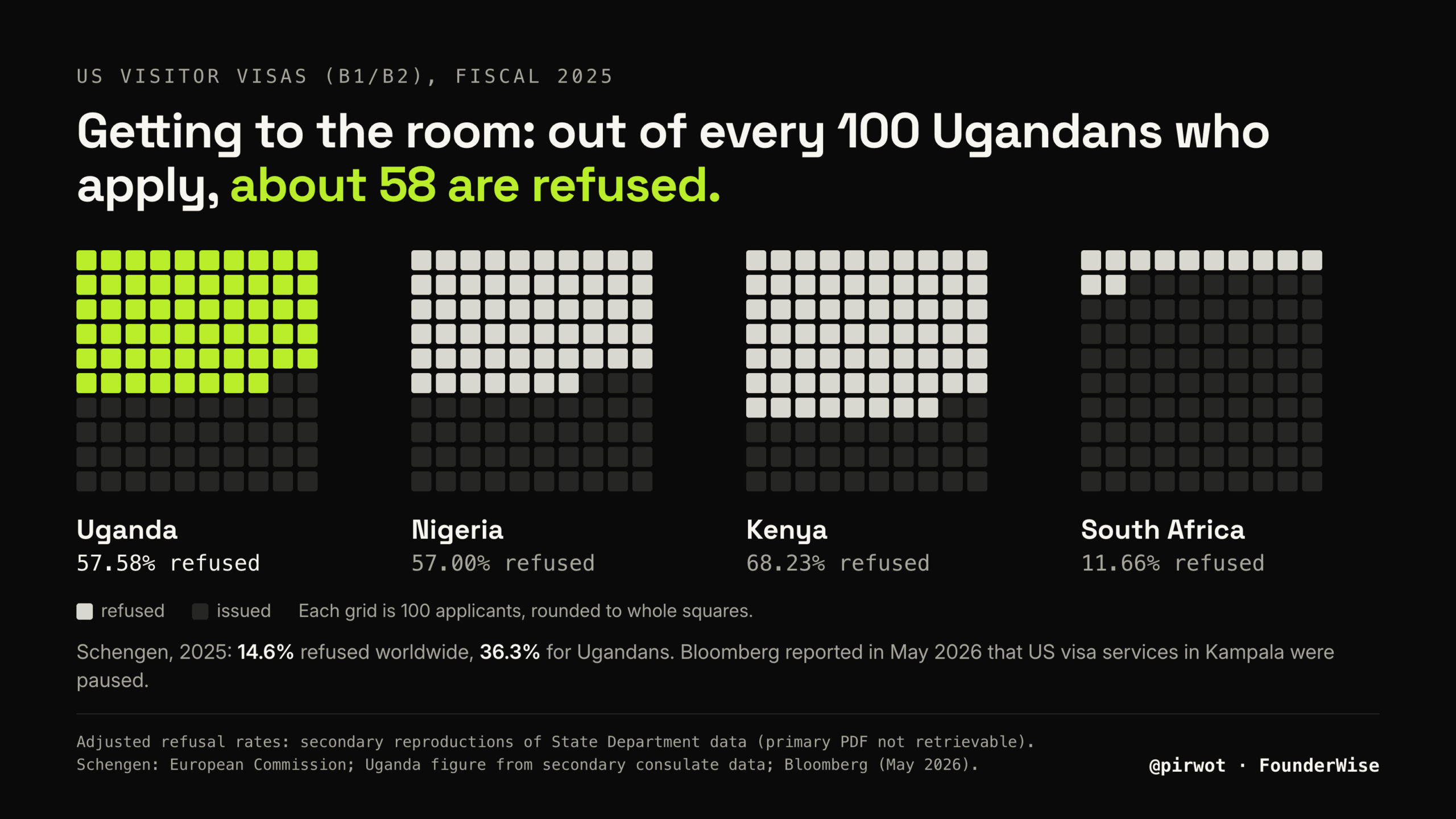
Every government has the right to decide who enters it. I’m only counting what it costs a founder from here to be in the room where decisions get made. For most, that means a better-than-even chance of refusal, a nonrefundable fee, and, since the pause Bloomberg reported, an open question about where to apply at all.
Companies that move before founders do
One way African founders have dealt with all of this is to move the company, even when the founder stays home.
Briter’s Africa Venture Pulse, published in August, found that 50% of African funding in the first half of 2026 went to entities incorporated outside Africa. Older AVCA data, via Launch Base Africa, found that 21% of African VC deals from 2014 to 2019 went to startups headquartered outside the continent, more than half of them incorporated in the US. YC’s deal page lists the corporations it invests in: US, Canada, Cayman and Singapore. The standard SAFE is written for Delaware.
I looked at the 13 African tech companies that have reached a billion-dollar valuation or market cap. Eleven of the thirteen are held outside their main operating country. Six have a founder who studied or worked in the US, and in two of those the US link is an American co-founder. Moniepoint is the clearest case of the company traveling while the founders stayed: both founders trained in Nigeria and worked at Interswitch, and the company still carries a US “Inc.” with a Delaware address and a London headquarters.
A Ugandan is part of this story too. Ham Serunjogi, a co-founder of Chipper Cash, studied economics at Grinnell College in Iowa and interned at Facebook in the US. Chipper is a Delaware entity headquartered in San Francisco.
An NBER working paper this year, by Colonnelli and colleagues using World Bank and VC4A data, found that about 80% of African VC deals involve a foreign investor and that two-thirds of funded founders studied or worked outside Africa. The share of founders who relocate after an accelerator is, as far as I can find, unmeasured, so I’ll leave that as an open question.
The flip is available to anyone, and I took it. FounderWise is a Delaware LLC. Stripe Atlas will form a Delaware company for $500, and Clerky will do it for $427. What I found is that forming the company is the easy step. Since 1 July 2025, Stripe has required a physical US presence for its Treasury and Issuing accounts, and it says an Atlas registered agent address is excluded. The major corporate card providers ask for a US physical address other than a registered agent or a virtual office. The block comes from where you are, not from your nationality.
Why I think the room is fair to use
I’m careful with this argument, because it slides into complaint very easily, and complaint builds nothing.
The American room was built. Decades of people put money into companies that failed, wrote the legal plumbing that makes a SAFE simple, funded universities, and carried risk that went unrewarded. The angels in New Hampshire’s count earned the right to invest near home. YC earned the right to decide that its founders should sit together in one city. Cloud providers are entitled to give their biggest credits to companies an investor has already vetted. A US founder who uses all of it is doing exactly what a sensible founder should do, and I’d do the same in their seat.
There’s also more here than the headline suggests. Uganda’s count of active equity investors more than doubled last year. Google Play supports developer and merchant registration from Uganda, and Apple lists a payout threshold in Ugandan shillings. Several of the continent’s billion-dollar companies, Moniepoint and Tyme among them, were built by founders who trained at home.
Making the evidence travel
What I take from all this is practical.
The American room is enormous and the door is narrow. When I went back over this year’s rejections and the card decline, most of them came back to one question: can anyone over there verify what we’re doing over here? An investor in San Francisco can check a Delaware filing in a minute. She has much less to go on when it comes to a founder’s customers in Kampala, a pilot upcountry, or cash that came in through mobile money. A card issuer checks an address. A credit bureau covers under 7% of adults. The work we do here is real.
The evidence of it tends to stay here.
So the job, as I see it, is to make the evidence travel. That means building a record of the real work that someone far away can read and trust without a visit, a visa or a warm intro. For a founder, it looks like this:
- This week, write down every customer conversation, with the date, the person’s role and what they said they’d pay. A number with a date carries further than a story.
- Within 30 days, test the smallest version of your product with real users, and keep the results in a form someone else can check.
- Starting today, keep a clean record of every shilling that actually comes in, by source and date, even when it’s small.
- Before your next application, ask what a reviewer who has never been to Uganda can verify from the application alone, and close those gaps first.
Every item on that list is in a founder’s own hands. It’s the part of the gap we control.
That’s what I’m building FounderWise to do. MVP Studio, the first piece, helps a founder test an MVP and turn the results into a record that holds up after it leaves the country. It went live yesterday, seven founders signed up in the first three hours, and revenue is still zero. I’d rather say that plainly.
I might be underrating how much a founder here can reach without ever getting through that door, through remote sales, a local investor base that’s growing, and neighboring markets. I’d like to be wrong about how much the door matters.
If you’re building from here and want to test your product the way an investor will read it, MVP Studio is open at app.founderwise.io/mvp. If you’d rather talk through where your evidence is thin before your next application, book a strategy call with me at cal.com/pirwot/strategy-call.
And if you’ve built in both places, I’d like to hear from you: once you were inside the American room, which advantage mattered most, the money, the people, or the infrastructure?
Sources
- PitchBook-NVCA Venture Monitor Q2 2026
- Crunchbase, H1 2026
- Partech Africa Tech VC Report 2025
- Africa: The Big Deal 2025
- Briter, Africa Venture Pulse 2026
- The EastAfrican on Uganda
- UNH Center for Venture Research
- Angel Capital Association
- ABAN 2025 Angel Survey
- Y Combinator deal and FAQ: deal and FAQ
- TechCrunch on YC and Africa
- Extruct, YC W26
- a16z speedrun
- AWS Activate
- Microsoft for Startups
- Federal Reserve, 16 Sep 2026
- SBA loan rates
- Bank of Uganda hold
- Uganda lending rates
- State Department visa refusal rates
- Bloomberg on Kampala
- NBER, “Startups in Africa”
- Stripe physical presence rule